Kyo Logic eSignature Add-on – How to turn a Database Feature into an Add-on

With the recent release of Claris’ FileMaker 19, Claris introduced a new tool called an Add-on, which allows you to drag and drop a ready-built feature into your database at the drop of a hat. Watch the video below to learn how to take an existing feature in a database and turn it into an Add-on. We will be using our eSignature Application as a base, so feel free to download that file and follow along.


eSignature Add-on Download

Please complete this form to download the FREE file.

This field is for validation purposes and should be left unchanged.
Name(Required)

Kyo Logic eSignature Application – Using the Power of CLARIS FileMaker 19 to Enhance your Application

With the recent release of Claris’ FileMaker 19, developers around the world are reveling in all of its new capabilities. Today we will be taking a deeper dive into two new capabilities WebDirect Card Windows and JavaScript in Web Viewers. We will show you how they can be utilized to greatly enhance your FileMaker database.

WebDirect Card Windows

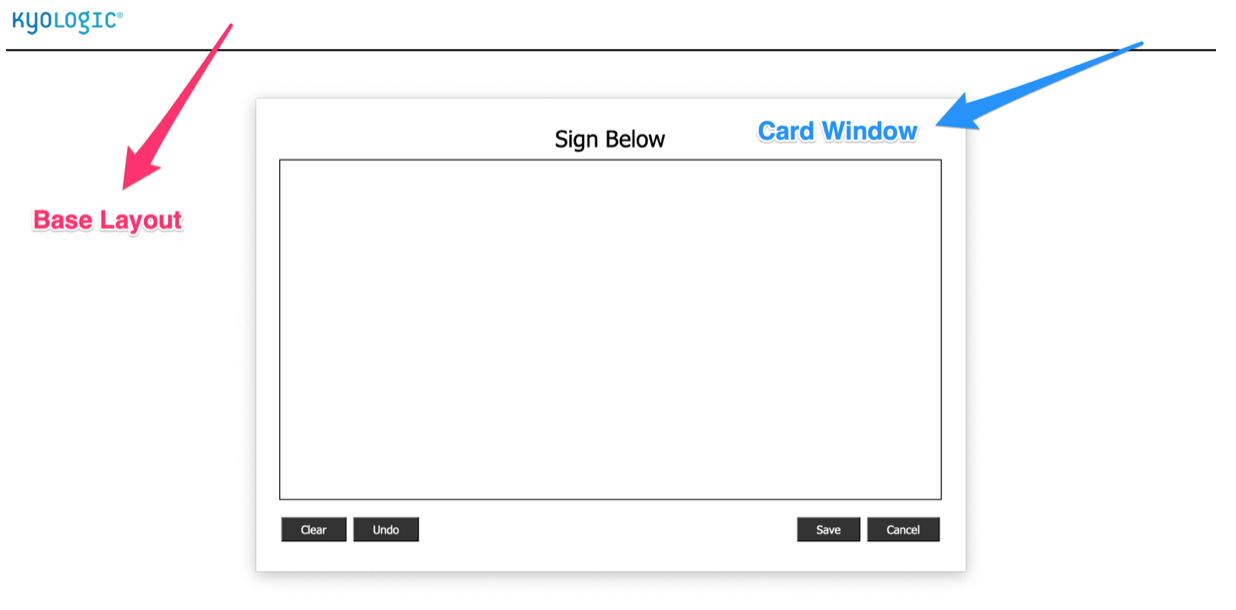
            Since the release of FileMaker 16, Card Windows have taken the FileMaker world by storm. They have allowed databases in FileMaker Pro and FileMaker Go to layer a window on top of another window as shown below.

Starting with FileMaker 19, this functionality has now been brought to WebDirect!

JavaScript in Web Viewers

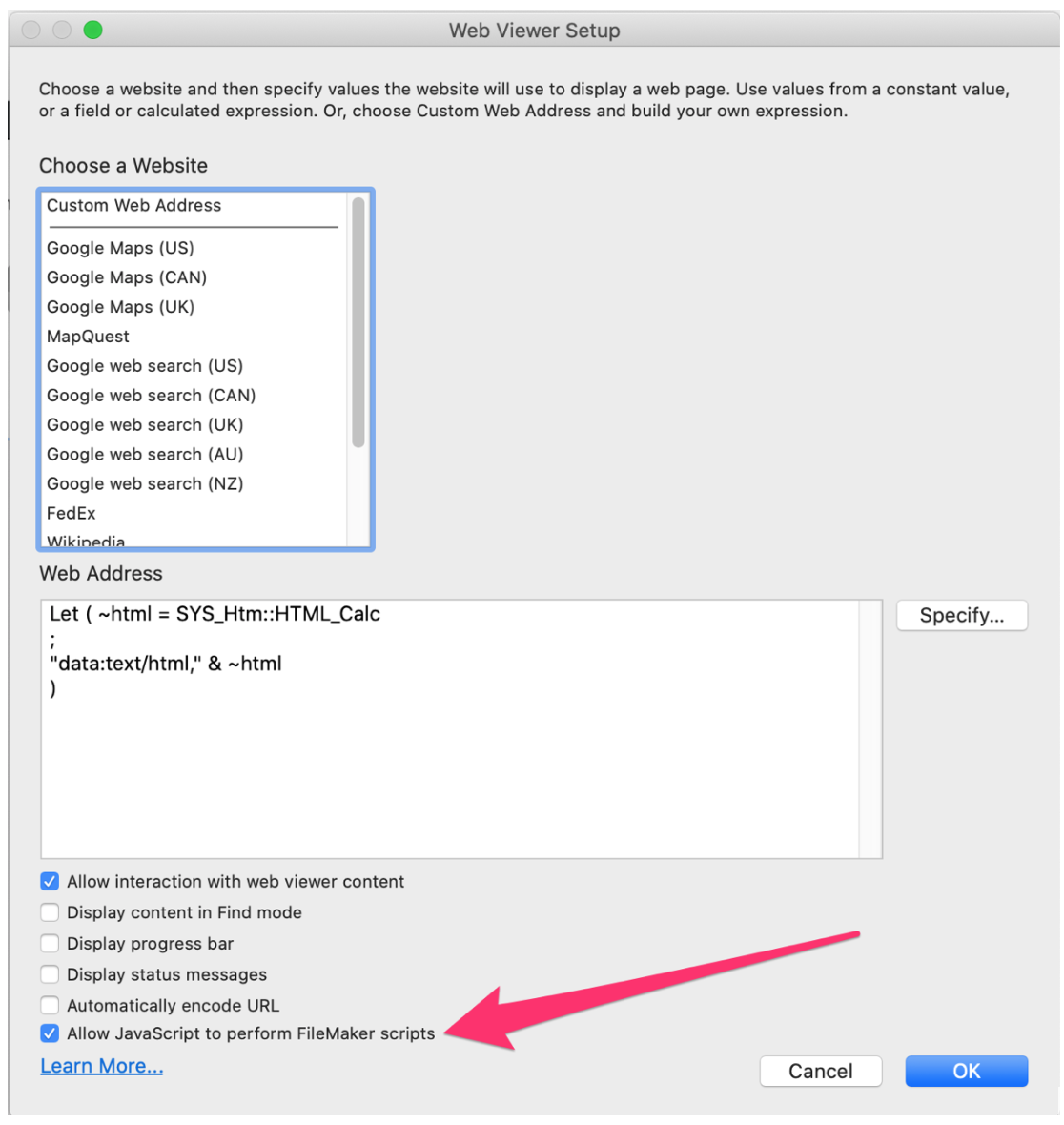
FileMaker has added a new function to Web Viewers called “Allow JavaScript to perform FileMaker scripts.” You can see below where to navigate to turn this on in the Web Viewer Setup.

What this allows you to do is enter the below JavaScript function into the JavaScript code in your Web Viewer. This will trigger a FileMaker script to be run as a result of an action taken within the Web Viewer.

[arve url=”https://kyologic.com/wp-content/uploads/2020/05/Signature.mp4″ /]

In the eSignature Application tool we utilize the open source signature pad code provided here https://github.com/szimek/signature_pad  (Thank you Szymon Nowak!) as the base for the web viewer code.

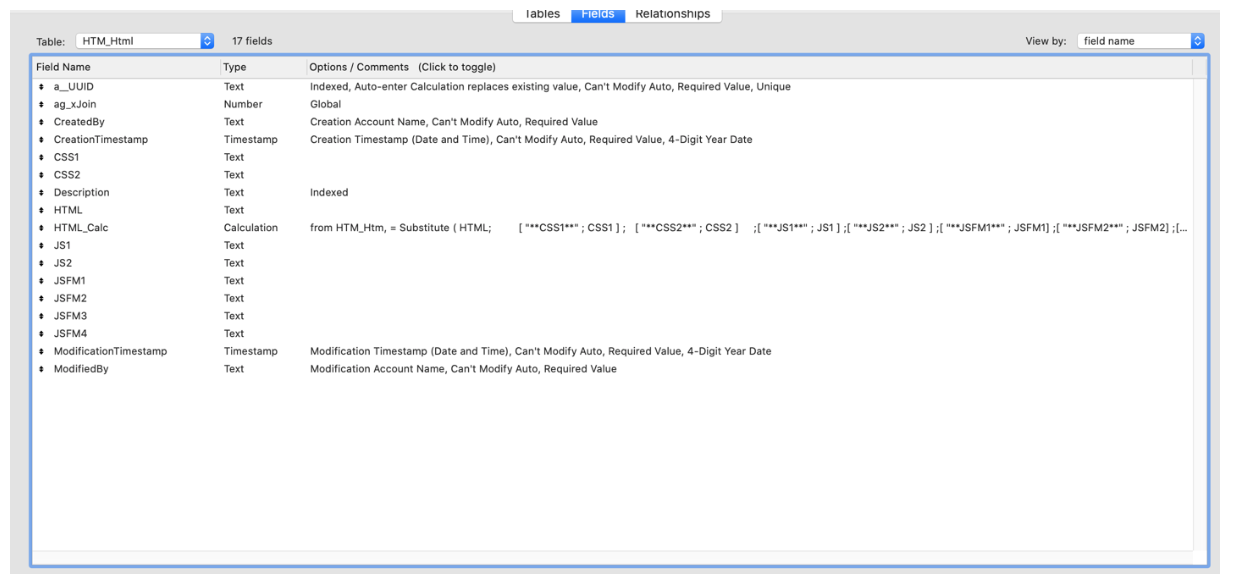
We have set up each element of the code in its own field in the HTM_Html table and combine the individual elements into the HTML_Calc field, which is what the Web Viewer reads and displays.

The elements in our code, which have been added to our FileMaker functions, are JSFM1 and JSFM2.

JSFM1 Is the Function that will be called upon selecting Save and JSFM2 upon selecting Cancel from within the Web Viewer.

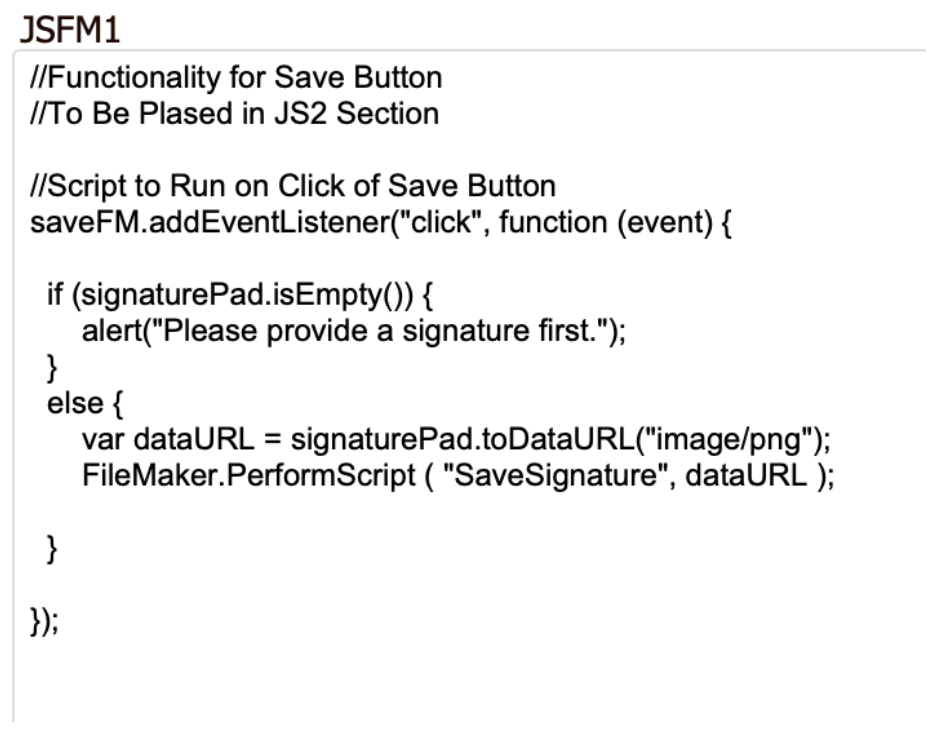
Here is a look at what the field JSFM1 contains:

As you can see here, when the Save button is clicked the function will run and, assuming that it is not empty, will first save the image as base 64 encoded text and then run the script SaveSignature in FileMaker.

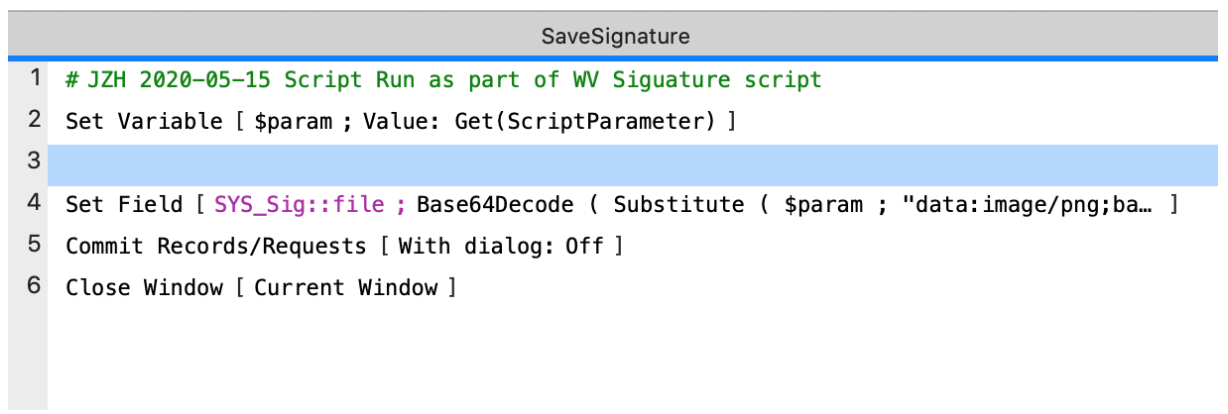
SaveSignature simply pulls in the dataURL as the parameter, decodes and formats it to be a png. Than sets it to the container field and closes the card window. It’s as easy as that. No more unnecessary data api work arounds!

It is important to note that with FileMaker 19, it is no longer necessary to base64 encode your web viewer code on WebDirect. In order for the FileMaker.PerformScript function to work from within a web viewer in WebDirect, the webviewer code cannot be base64 encoded and must start with datatext/html,

Download eSignature Application

Please complete this form to download the FREE file.

This field is for validation purposes and should be left unchanged.
Name(Required)

One-time Setup Navigation Bar

Why implement a standard navigation bar across the system?

For most systems, it is imperative that the user can get to many areas of the system in only a few clicks. Implementing this method of system navigation not only solves this problem, but also has some other benefits. It brings clarity to which area of the system the user is in, promotes standard navigation behavior which helps the user experience, and is very easy to manage and update once implemented

What does it look like?

Without using a standard navigation bar, keeping things updated over time can be very time consuming and sloppy to manage.

By using this system, you only need to do a major setup one time. From there, any new layouts or modules will adopt and fit into the existing system without issue. You avoid having to go back to all other layouts and update their individual button bars.

Example: Adding a new module

In this case, I added the “ContactInfo” table and created a Form and List view to display this data. To update the navigation bar, all I needed to do was update one script and my navigation was already completely set up!

The video below demonstrates this update and also showcases how the nav-bar is automatically updated on all layouts.

There are a few key components to setting up this system navigation.

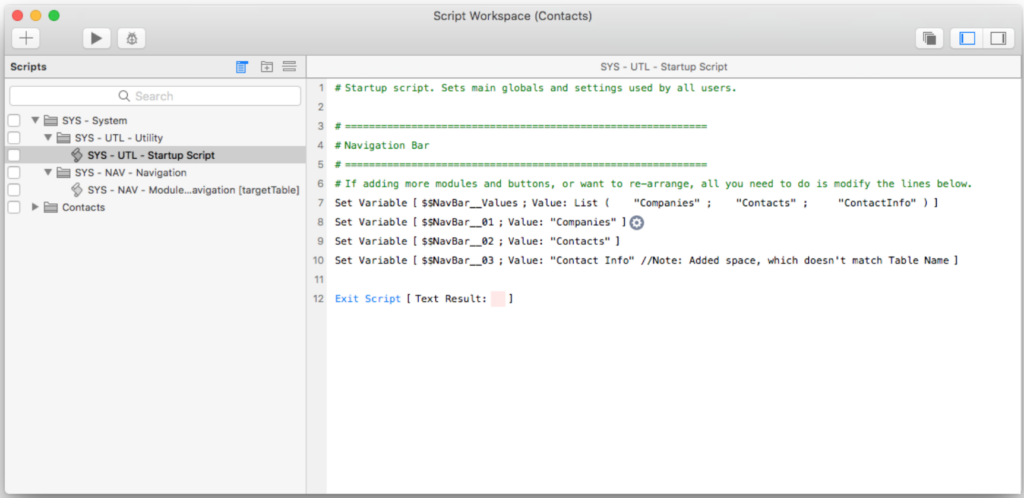
  1. Startup script
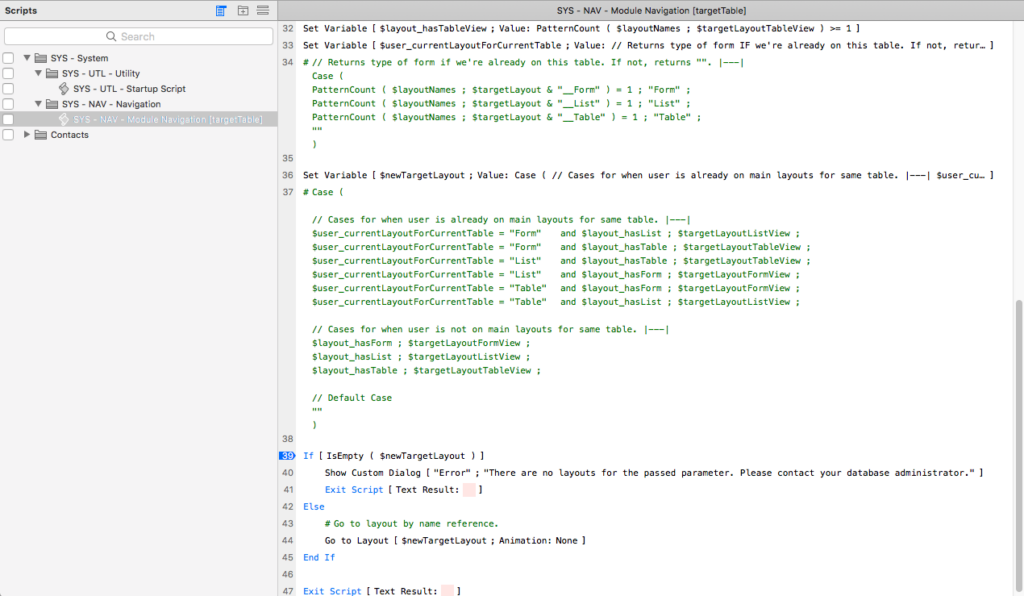
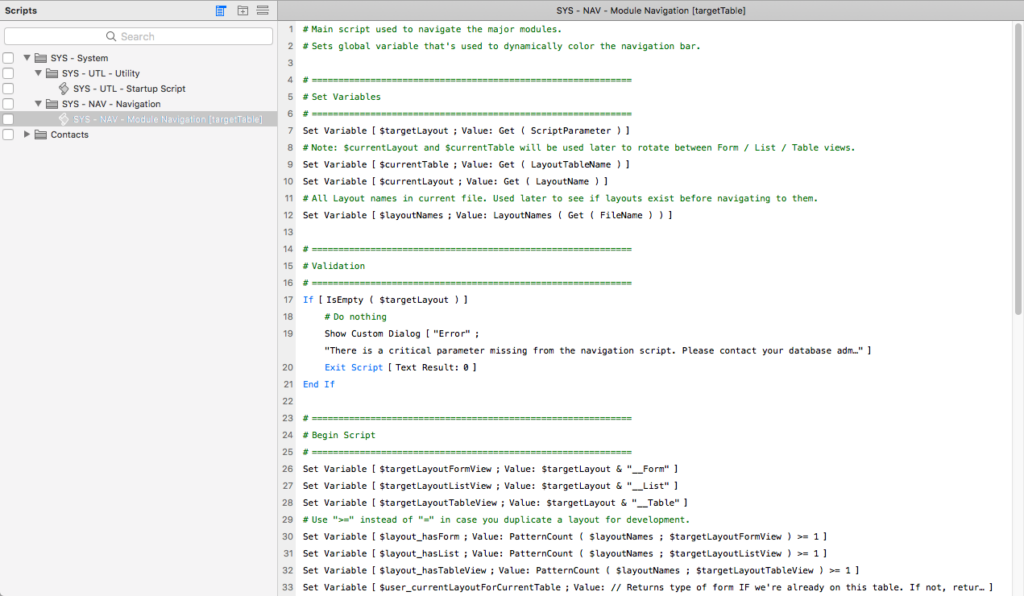
  2. Navigation script
  3. Layout naming convention
  4. Layout objects

1. Startup Script

2. Navigation Script

3. Layout naming convention

4. Layout objects

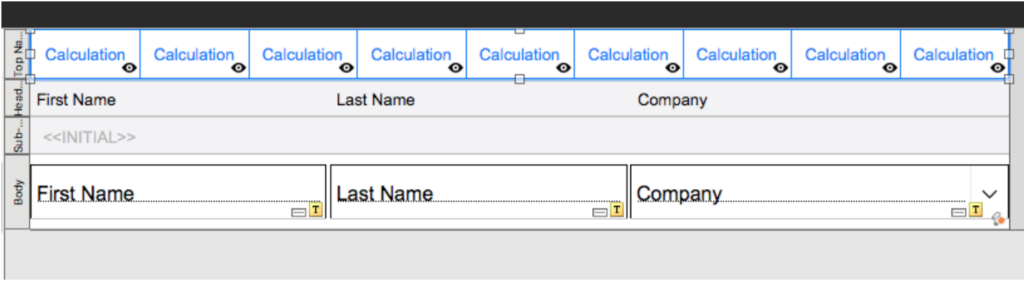
Layout in Browse mode

Layout in Layout mode

Naming convention for each individual button. Used in the “Active” calculation

Hide the condition for each individual button.

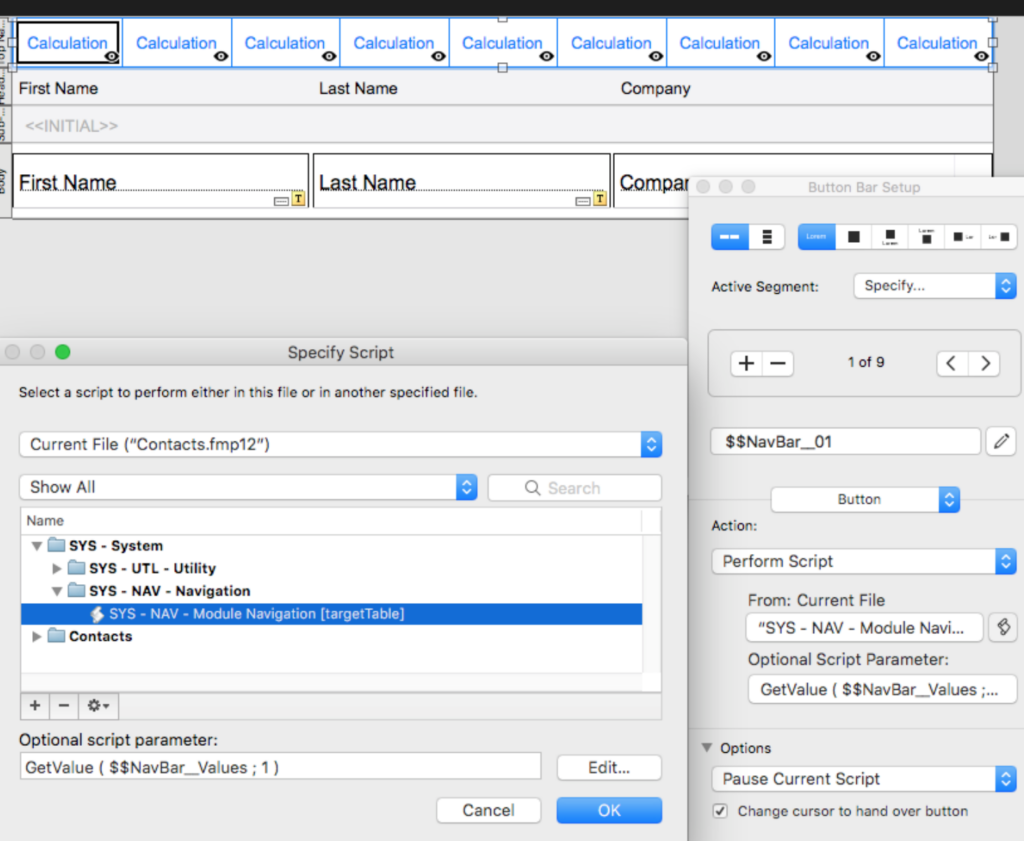
Setup for each individual button

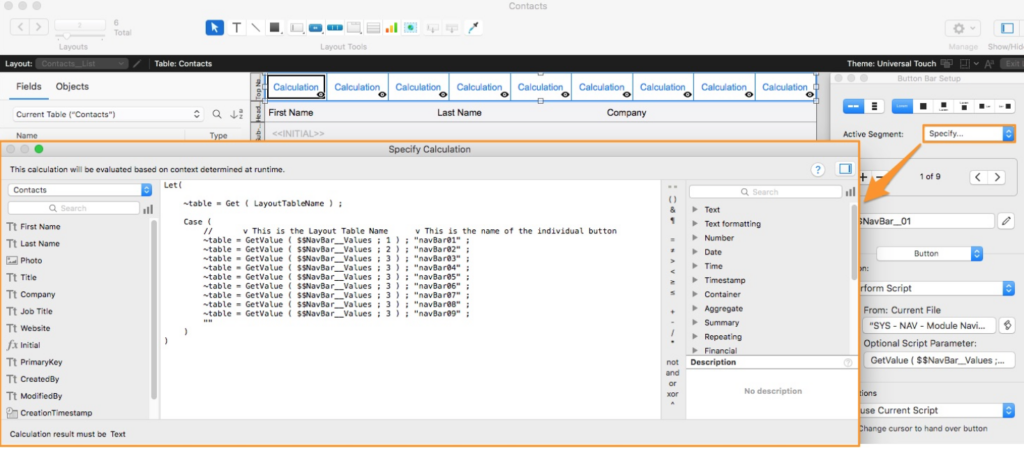
Setup for Active Calc

In Conclusion: Adding a new module

Utilizing this Navigation Bar can save many hours in the long run, especially if you make frequent updates or additions to your system(s).

If you’re struggling with implementing any of these concepts, or have any questions, please feel free to email support@kyologic.com where we can help you further!

The Session Table

What is it? Why should every file have it? How do you add it to your file?

What is it?

The Session Table is a utility table created for each individual instance of a user’s access to a file. It is created upon entry of the file (OnFirstsWindowOpen script trigger) and closed out upon shut down (OnLastWindowClose script trigger) of the file.

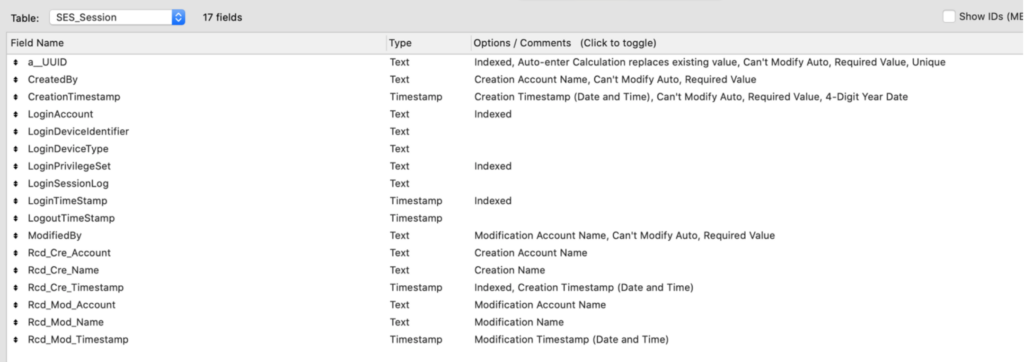
This is a sample of what a Session Table would look like in the Database Manager:

Why Should Every File Have it?

  • Helps to track Users Entry and Exit from File – It is critical that administrators know who is entering and how often and how long they are staying in the file. This can be useful for analytical purposes as well as for security. If you know that something malicious happened in a file during a specific period of time, you can go to the Session table to find the users who were in at that exact time.
  • Collects User metadata – Using FileMaker’s built-in calculation functions, you can acquire metadata about the user such as the type of device they are using, how they are accessing FileMaker (FileMaker Pro Advanced, FileMaker Go, WebDirect, etc.), the user’s IP address and many more pieces of information. Being aware of all of this can help the file administrators analyze what kind of user is spending time in their file in order to help make decisions.
  • Can be utilized to track user actions – If it is imperative that all user actions are tracked (an example being for HIPAA compliance) then the session table is where this can take place. You can create a login in the Session Table by using script triggers on fields and layouts.
  • Can be utilized for Creating Session-Based Tables – There may come a situation where you have to build a report or list that combines multiple data into one table multiple users can access this at the same time. As a result, there needs to be a way to distinguish which records are for which user session to make sure that one user does not see other users’ data. The Session table comes in use here. By utilizing the user’s specific session ID, you can determine which records are for that user’s list/report simply by including their session ID. This can be quite complicated, so we will have a blog in the future based solely on this topic.

How can you add it to your file?

After creating the Session table, you must make sure it is connected to your files GLOBAL, SYSTEM, or UTILITY table (this table should be the table in the file that contains all global fields).

At Kyo Logic, we like to name our global table the SYSTEM Table. (We also like to use three-letter codes as part of the names of our tables to make the table occurrences in the relationship graph easier to understand). And we connect SYSTEM (SYS__Sys) to SESSION (SYS_SES__AC) through this simple relationship:

Now that we have the infrastructure in place, we need to build the script to create the Session record.

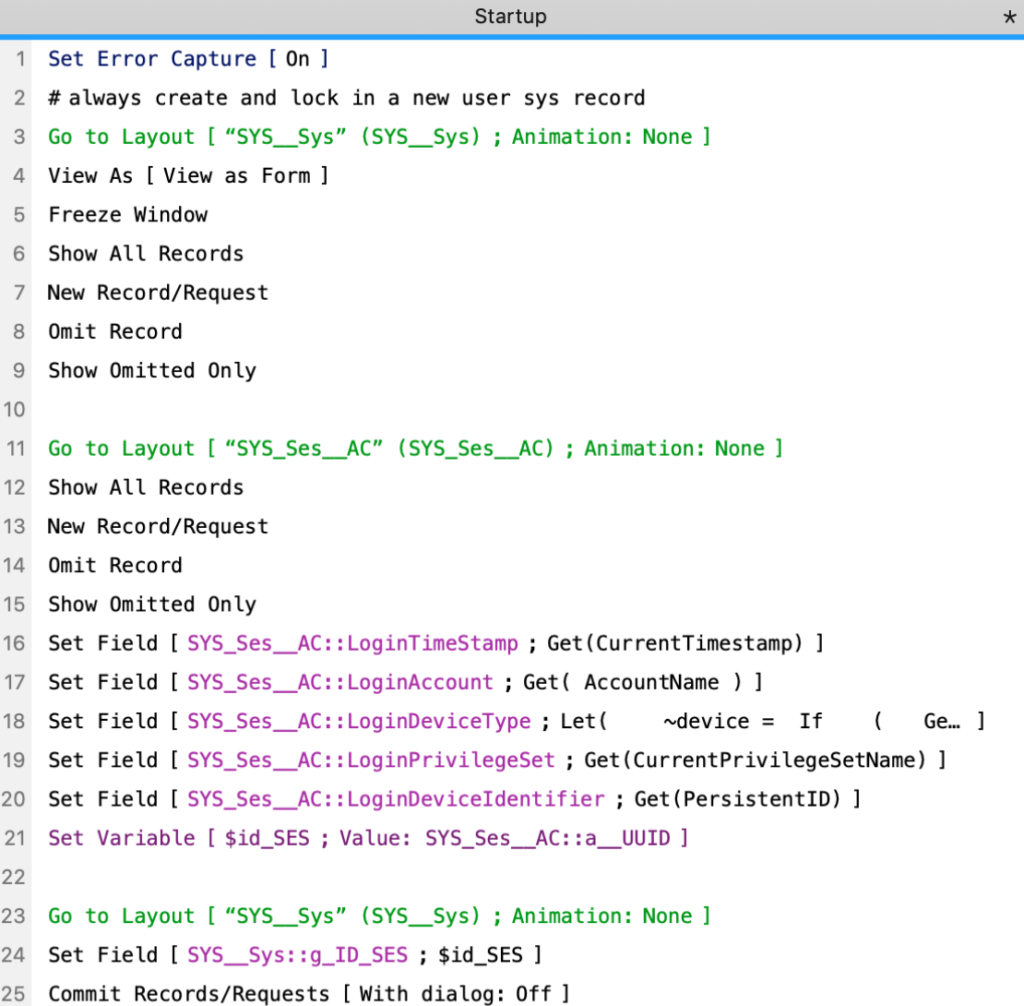
The script that we have built, “Startup,” we have running OnFirstWindowOpen.

This script first creates the user’s unique SYSTEM record and then creates their unique Session record. It then sets all of the metadata fields that you would want to acquire. Finally, it sets the user’s Session ID to a SYSTEM global field so that the file can obtain the user’s session ID at any time.

We also include the “shutDown” script OnLastWindowClose to set the logout metadata field.

And, there you go. You now have a session table that you can use to track your user access into the file and so much more!

Welcome FileMaker 17!

FileMaker 17 Overview!

FileMaker 17 is finally here, and we are excited to review all the new features included! FileMaker releases new versions of the powerful database annually and this year may be the best release yet. In this post, we will review all the new features that have been released in FileMaker Pro Advanced, FileMaker Go, FileMaker Server, FileMaker Cloud, and FileMaker WebDirect. In separate articles, we will provide a more in-depth look at some of our favorite new features and a breakdown of the new licensing programs!

What’s New in FileMaker 17!

  • Layout Mode was redesigned for streamlined development
  • FileMaker now allows users to add default fields when you create new tables
  • FileMaker will now be able to handle multiple email attachments
  • FileMaker Data API is no longer a trail feature and supports scripts and uploading files to container fields
  • FileMaker Go will now support local notifications
  • Users can now drag and drop text, photos, and files between apps while using FileMaker Go!

Development

Group Object Selection

While developing in FileMaker you have had the ability to group together objects but when you needed to modify, reposition, or resize an individual object inside the group you would have to undo the groupings. With the Group Object Selection, you are able to select individual objects within a group and modify as needed.

Redesigned Layout Mode

FileMaker has redesigned layout mode for a more streamlined design environment. The Inspector, Fields tab and Objects tab will now be pinned inside the document window, so you will no longer lose them on other screens while working!

Default Fields

Most developers include a group of standard default fields in every application that is created, FileMaker has now added default fields to help streamline the process of creating new fields such as primary key, creation date, modification date, and who the record was created or modified by. Just add a new table within FileMaker and these fields will automatically be created. These fields can be customized or removed via an XML file.

Scripting Enhancements

FileMaker has added two new scripting enhancements to FileMaker 17. First, they have enhanced the Perform Script and Perform Script on Server script steps by adding the ability to specify which script should run by name. Second, They have added support for using variables in the input field to populate and retrieve text within a Show Custom Dialog script step.

Multiple Email Attachments

FileMaker has had the ability to send emails directly from your application for some time but up until now, users have been limited to only one attachment. In FileMaker 17 users will now have the ability to add multiple attachments when sending emails.

Copy and Paste Custom Menus

Save time while developing but reusing custom menus that you have created in other FileMaker apps. All you have to do is copy menu sets, menus, and menu items and paste them into your file!

FileMaker Data Migration Tool

Using the FileMaker Data Migration Tool developers will be able to cut the time it takes while importing large data sets in half. The new command-line tool will help when you update your deployed custom apps.

Deployment

FileMaker Server Admin Console

For easier administration of FileMaker applications, the FileMaker Server Admin Console was redesigned to provide a streamlined user interface. The Admin Console will feature a Dashboard page to easily monitor hosted apps, connected clients, and system statistics. Administrators will also receive notifications that will provide more detail on how to handle errors if they occur.

Work While Reconnecting

If a network connection to FileMaker Server is lost while you are working you will be able to continue working on files that do not depend on the host until the connection is restored.

Cloud

FileMaker Cloud will support all new features for FileMaker 17. Users will also have the ability to use the Comodo SSL certificate for 60-day free trails.

Mobility

Configure Local Notification

FileMaker Go will increase iBeacon technologies to include local notifications. Any iPad or iPhone that is using FileMaker Go that is running in the background will display local notifications such a meeting reminds, or when an iBeacon is near. Just set up scripts that will send local alerts based on info from your device!

Auto-Complete

Auto-Complete has been a great tool on the Desktop in FileMaker Pro but now this feature will be coming to FileMaker Go! Start typing a letter or two into a text field and a list of items that match what you are typing will appear!

Drag and Drop

FileMaker users will not have the ability to drag and drop text, photos, and files between apps on the iPad while running a minimum of iOS 11.

Integration

FileMaker Data API

FileMaker first introduced the FileMaker Data API as a trail in FileMaker Server 16 as an easy way to integrate your FileMaker data to other popular apps and we services using the industry standard REST API. In FileMaker 17 this will no longer be a trail and will include powerful new features including support for FileMaker Server scripts and the ability to upload files to container fields. FileMaker has also added more standardized API formats to make the FileMaker Data API easier to work with.

Security

Account Lockout

Security has been the main focus for FileMaker in the most recent releases. To continue strengthening security throughout the FileMaker Platform, users will now be temporarily locked out of accounts after failed login attempts. Users must wait 5 minutes before they can attempt to log back in.

To learn more about FileMaker 17 or incorporate these awesome new features in your FileMaker database today give Kyo Logic a call!


Introduction to FileMaker and SQL

Introduction to FileMaker and SQL

Are you looking for a way to take your FileMaker Database to the next level? Harnessing the power of SQL in FileMaker can help you streamline and easily access more of your data.

What is SQL and what are the benefits?

SQL is an abbreviation for structured query language and is a standardized programming language best used for managing a relational database. SQL also allows you to perform various operations on data and is used by developers to write data integration scripts and setting up and running analytical queries.

When using SQL in FileMaker you can there are many different benefits such as:

    • Quickly obtaining data for use in scripts
    • Versatility: Summarize, Join, Union, Find Within
    • Requires no persistent structures
    • Potentially very fast
    • Completely programmable

Well, this all sounds great but how do you get SQL to run in FileMaker?

With the latest versions of FileMaker, you can utilize the ExecuteSQL() function right within FileMaker which will allow you to perform select queries. SQL works well with Let functions and is often used to store data in global variables. Both simple or complex arguments can be entered into an SQL statement.

Additional FileMaker and SQL Recourses:
Conclusion

SQL is a great way to utilize your data in FileMaker. Whether writing simple or complex arguments you will be able to quickly use the ExecuteSQL() function in FileMaker to perform queries.

If you would like to harness the power of your data in FileMaker but do not want to do the heavy lifting contact us today.

Tips and Tricks for Creating Dashboards in FileMaker

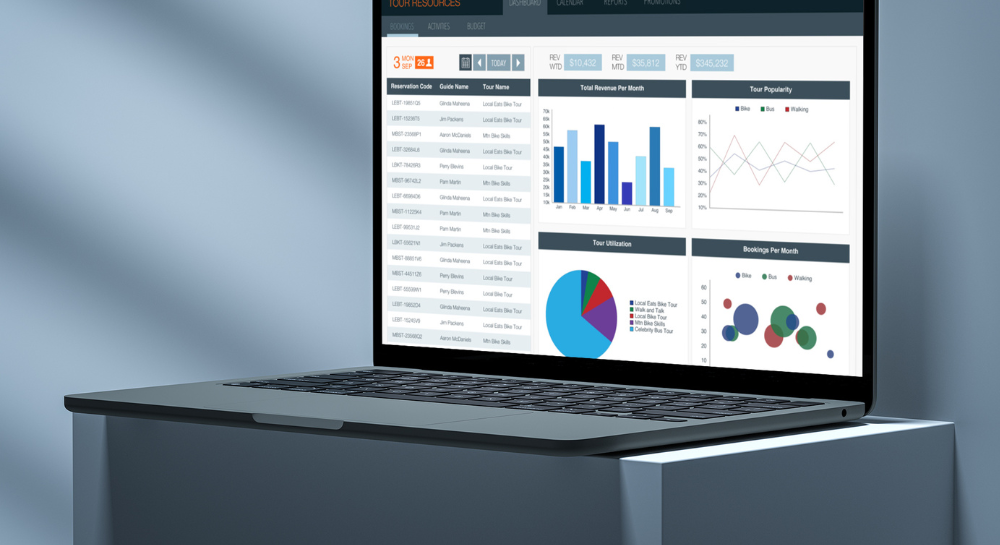
Do you have a FileMaker database that you use to manage your business processes? Are you looking for a tool that will allow you to see summarized and centralized data about your company in one easy view? Creating Dashboards in FileMaker will allow you to harness the power of your data to help your business run more efficiently.

FileMaker provides many excellent tools for creating powerful Dashboards that allow you to quickly scan information and identify important areas needing attention.

Follow along with John Mathewson of Kyo Logic as he walks through setting up and implementing Dashboards in FileMaker.

During the webinar you will learn: 

  • Approaches for creating dashboards
  • Tips for successful implementation in your organization
  • Using pivot tables and graphs
  • How to establish Key Performance Indicators (KPIs)

Download Dashboards Demo

Please complete this form to download the FREE file.

This field is for validation purposes and should be left unchanged.
Name(Required)

Welcome to the family FileMaker 16!

Welcome FileMaker 16, the newest version of FileMaker is here!  The new release will help make creating custom apps with FileMaker even easier! Let’s walk through all the new features of FileMaker Pro 16, FileMaker Go 16, and FileMaker Server 16. Also, join us May 22nd for a live FileMaker 16 Demo!

New features in the FileMaker 16 Platform:

Mobility:

Animations & Transitions, enhanced signature capture, region-monitoring script, custom paper sizes

Development:

Layout Objects windows, Cards, pdf support in FileMaker Server and FileMaker Webdirect, new Windows OS interface, copy/paste value list, variables in FileMaker data source references, enhanced Data Viewer

 Integration:

Enhanced cURL options, JSON functions, FileMaker Data API, Tableau Web Data Connector for FileMaker, external script steps

 Security:

OAuth 2.0 support for accounts, clickable security lock icons, field-level text encryption 

Scalability:

FileMaker WebDirect scalability

FileMaker 16 Live Demo:

Join us for an exclusive event showcasing the new FileMaker 16 Platform. Discover how the new FileMaker Platform lets you create custom apps that work for your team on iPad, iPhone, Windows, Mac, and the web. See how the new features improve the mobility, development, integration, security, and scalability of your custom apps. Join us for this exciting live event and bring a laptop to try FileMaker 16 for yourself!

Date: May 22nd, 2017
Time: 12 pm to 2 pm
Location: Kyo Logic office, 37 North Ave, Suite 105 Norwalk, CT 06851
Register Here

Need to upgrade to FileMaker 16? Kyo Logic is a certified reseller and can help you upgrade or purchase FileMaker licenses! Call us at 203.221.3033!

Learn More About FileMaker Cloud Hosting!

FileMaker Cloud

Are you looking for a better way to host your FileMaker solution? Do you spend hours trying to manage your current hosting software? Would you like an easy way to host and manage your FileMaker database so you can share all data with all users? Have you heard of FileMaker Cloud but not sure what it is?

If that’s a yes, then join Kyo Logic and Ronnie Rios at this months CT FileMaker Developers Group! Ronnie is the Senior Consulting Engineer at FileMaker and all around FileMaker Guru! On February 15th at 10 am Ronnie will show us the ins and outs of FileMakers newest product, FileMaker Cloud. FileMaker Cloud provides secure and reliable access to all your FileMaker custom apps without the knowledge and admin hassle of traditional hosting!

If you would like to learn more about FileMaker cloud hosting join us February 15th at 10 am! For more information or to register join our meetup, http://meetu.ps/35D9wN or call 203-221-3033!

Don’t Host that File — Audit it First!

Screen Shot 2016-03-18 at 9.03.38 AM

Will you be attending FileMaker’s DevCon 2016? If you have not bought tickets already you will not want to miss this great event to learn all things FileMaker!

This year Kyo logic’s Tim Neudecker will be presenting, “Don’t Host that File — Audit it First!“, Thursday July 21st at 3:45pm! For any company or IT department that will be hosting files you will not want to miss this great presentation to make sure your files are always secure!

Session Description

Before you host your brand new FileMaker custom app, you should perform a security audit. This will help you sleep at night knowing your data is safe from intruders.

In this session, we will review all aspects of file security from basic privilege sets and extended privileges to encryption at rest. We’ll also discuss server security, including physical security, proper configuration, and purchasing and installing SSL certificates.

What You Should Know

Basic understanding of the FileMaker Platform

What You Will Learn
  • Privilege sets and extended privileges
  • Encryption at rest
  • File access permissions
  • SSL certificates