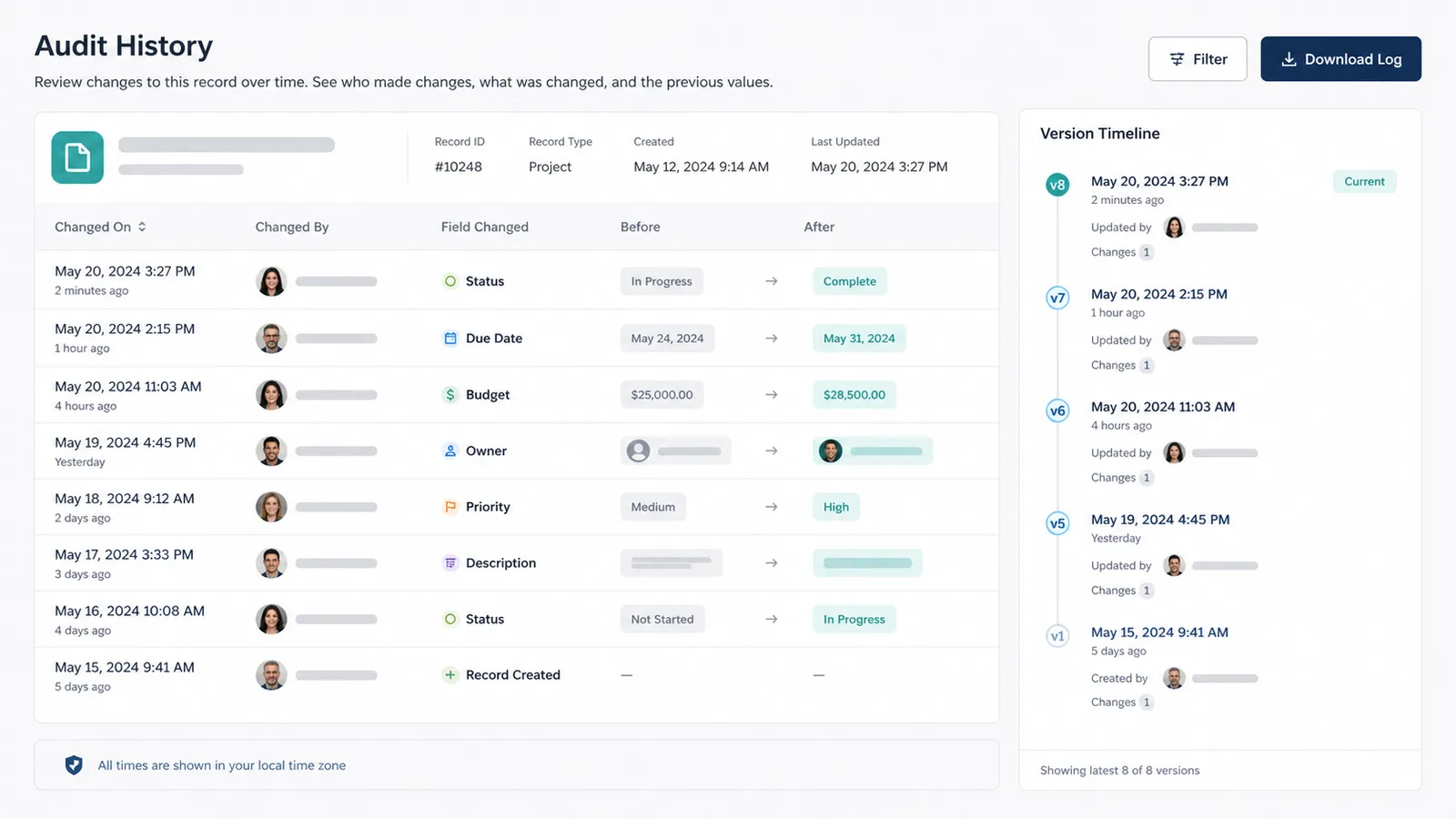
CRM Cleanup: Using FileMaker to Standardize, Merge, and Validate Customer Data

Over the course of a year, CRM data naturally degrades. Duplicate contacts, inconsistent fields, outdated information, and incomplete records can undermine sales, marketing, and customer success efforts. The New Year is the ideal time to clean house, and Claris FileMaker makes CRM cleanup systematic, automated, and reliable.


Standardize Fields and Data Formats

FileMaker can enforce consistent standards across CRM records by:

  • Normalizing field formats (emails, phone numbers, addresses)
  • Applying validation rules
  • Flagging incomplete or invalid entries
  • Standardizing naming conventions and categories

Automated scripts can scan the entire database and surface issues for review or correction.


Merge Duplicate Customer Records Safely

Duplicate records are one of the most common CRM problems. FileMaker scripts can identify duplicates using matching logic such as:

  • Email addresses
  • Company and contact names
  • Phone numbers
  • External IDs

FileMaker can safely merge these identified records, preserving historical data such as activity, notes, and relationships while eliminating redundancy.


Verify and Prepare Contact Data for Outreach

Before launching next year’s campaigns, FileMaker can help verify:

  • Missing contact details
  • Invalid emails or phone numbers
  • Inactive or disengaged accounts
  • Inconsistent segmentation or tagging

This ensures sales and marketing teams start the new year with clean, trustworthy data.

Why It Matters

Year-end CRM cleanup with FileMaker allows organizations to:

  • Improve campaign performance
  • Reduce bounced emails and failed outreach
  • Increase sales productivity
  • Strengthen reporting accuracy
  • Build better customer experiences

Clean data is not just operational hygiene. It can be a major competitive advantage.

Claris FileMaker provides powerful tools to standardize, merge, and validate CRM data before the new year begins. By automating cleanup processes, organizations ensure their customer data is accurate, actionable, and ready to support growth in the year ahead.

Interested in cleaning up and modernizing your CRM with Claris FileMaker?
Reach out to Kyo Logic here.


Automate EOY Tax Document Preparation with FileMaker

Year-end tax preparation often requires pulling data from multiple systems, reconciling totals, and manually generating reports. This process is time-consuming and prone to errors—especially for organizations managing large vendor lists or complex payroll structures. With Claris FileMaker, businesses can automate tax document preparation and generate accurate, audit-ready outputs with minimal manual effort.

Centralize Tax-Relevant Data

FileMaker can consolidate tax-related information, such as:

  • Vendor payments
  • Contractor compensation
  • Payroll summaries
  • Expense reimbursements
  • Withholding data

By storing this information in a structured database, FileMaker ensures totals are accurate and consistent across reports.

Automated 1099 and Vendor Summaries

Custom FileMaker workflows can automatically calculate:

  • Total annual payments by vendor
  • 1099-eligible compensation
  • Threshold checks
  • Category-based summaries

This allows teams to generate 1099 summaries or export-ready datasets without manually filtering spreadsheets.

Generate Tax-Ready Reports and Exports

FileMaker can produce:

  • Internal review and approval reports (Move to top bullet)
  • CSV or Excel exports for tax software
  • Vendor-specific breakdowns

Because reports are generated from live data, updates are applied instantly when corrections are made.

Integrate with QuickBooks

Beyond generating essential in-house reports, FileMaker excels at integrating with external accounting platforms, most notably QuickBooks. This connection is critical for streamlining the End-of-Year tax preparation process.

  • Exports structured vendor/expense data in QuickBooks-compatible formats.
  • Reconciles internal data with QuickBooks before export, flagging discrepancies.
  • Maintains a complete audit trail linking internal processes to QuickBooks financial data

This integration ensures accurate, timely, and fully documented data for tax professionals, smoothing the transition to official tax filing.


Why It Matters

Automating tax preparation with FileMaker helps organizations:

  • Reduce manual errors
  • Save time during year-end close
  • Improve compliance accuracy
  • Maintain clear audit trails
  • Respond faster to accountant or auditor requests

Tax prep becomes predictable and repeatable instead of stressful and reactive. Claris FileMaker can send and receive data directly to accounting packages like QuickBooks Online, simplifying the preparation process.

Claris FileMaker simplifies year-end tax document preparation by automating calculations, consolidating data, and generating tax-ready reports. With the right workflows in place, organizations can approach tax season with confidence and control.

Want to automate tax reporting and documentation with Claris FileMaker?
Reach out to Kyo Logic here.

Year-End Budgeting & Expense Tracking in FileMaker

Year-end budgeting often exposes the limitations of spreadsheets. Version conflicts, manual updates, and disconnected expense data make it difficult for teams to collaborate or trust the numbers. With Claris FileMaker, organizations can replace spreadsheets with a centralized budgeting and expense-tracking system that updates in real time and stays synchronized across teams.

Centralize Budget and Expense Data

FileMaker allows finance teams to consolidate all budgeting and expense data into a single system, including:

  • Department budgets
  • Actual expenses
  • Forecasted spend
  • Vendor costs
  • Project or initiative allocations

Data can be imported or integrated from accounting systems, purchasing tools, or expense platforms, creating a single source of truth for year-end planning.

Real-Time Budget Visibility Across Teams

Instead of waiting for monthly spreadsheet updates, FileMaker dashboards show live budget performance:

  • Budget vs. actual spend
  • Remaining budget by department
  • Overages and variances
  • Year-over-year comparisons

Because FileMaker updates instantly as expenses are logged or approved, stakeholders always see the most current numbers. A powerful graphing engine shows trends at a glance.

Collaborative, Role-Based Access

FileMaker supports role-based access, allowing:

  • Department heads to submit or review expenses
  • Finance teams to manage approvals and adjustments
  • Executives to view high-level summaries

This eliminates email chains and spreadsheet handoffs, while maintaining control and accountability.

Why It Matters

Replacing spreadsheets with FileMaker helps organizations:

  • Improve budget accuracy
  • Reduce manual reconciliation
  • Speed up year-end close
  • Increase transparency across teams
  • Prepare more reliable budgets for the new year

Budgeting becomes a living process instead of a static, once-a-year exercise.

Claris FileMaker gives organizations a smarter way to manage year-end budgeting and expense tracking. With real-time data, collaborative workflows, and centralized reporting, teams can plan confidently—and enter the new year with clarity.

Interested in replacing spreadsheets with a custom budgeting system in Claris FileMaker? Reach out to Kyo Logic here.

Sending Calendar Invites through FileMaker Pro

FileMaker is often the system of record for projects, cases, inspections, and client interactions. Yet meeting coordination frequently happens outside the system that owns the data, in inboxes, chat threads, or third-party scheduling tools. Over time, this disconnect creates friction, missed context, and unnecessary manual work.

Sending calendar invites directly from FileMaker helps close that gap. It allows meetings and appointments to be generated as part of a workflow, tied directly to the records that define them, without introducing plug-ins, external APIs, or additional services.

Using only native functionality available as early as FileMaker Pro 18, FileMaker can generate standard iCalendar (.ics) files and send them as email attachments that are recognized by most modern calendar clients.

How iCalendar Invites Work

Calendar invitations are distributed as .ics files that follow the iCalendar (RFC 5545) specification. When attached to an email, calendar applications such as Outlook, Apple Calendar, and Google Calendar detect the file and prompt the recipient to accept, decline, or tentatively accept the event.

From FileMaker’s perspective, this is a simple process:

  1. Assemble the meeting details in iCalendar format
  2. Write the formatted text to a .ics file
  3. Attach the file to an email

Because .ics files are plain text, FileMaker’s Data File script steps provide everything needed to create them programmatically.


Why This Matters in Real FileMaker Systems

Automated calendar invites are most valuable when they are driven by record state and business logic rather than manual steps.

Common scenarios include:

  • Project and client meetings
    Automatically generate calendar invites when a project meeting is scheduled or updated, ensuring all participants receive consistent details tied directly to the project record.
  • Inspections and site visits
    Send calendar invites to inspectors or field staff when inspections are assigned, reducing missed appointments and improving coordination across time zones.
  • Healthcare or laboratory scheduling
    Create appointment invites directly from FileMaker without relying on third-party scheduling platforms that may introduce compliance or data exposure concerns.
  • Internal reviews and approvals
    Schedule internal handoffs, audits, or review meetings as part of a controlled FileMaker workflow, keeping operational events aligned with the data that drives them.
  • Automated follow-ups
    Trigger calendar invites based on record changes such as contract approval, equipment readiness, or milestone completion, removing manual coordination steps.

In each case, the calendar invite becomes an output of the system, not a separate process users must remember to perform.


Important iCalendar Considerations

While the overall approach is straightforward, there are several rules and quirks to be aware of when generating .ics files.

  • Line length limits
    Each line must be no longer than 75 characters. Longer values, such as meeting titles or descriptions, must be folded onto additional lines. Continuation lines must begin with a space or tab character.
  • Time zones and daylight saving time
    Date and time values should be carefully formatted, typically using UTC (Z) timestamps. Incorrect handling can cause meetings to appear at the wrong time for recipients.
  • Invitation behavior
    The METHOD property determines whether recipients are prompted to respond (REQUEST) or whether the event is simply added to their calendar. This choice affects how invites behave across different clients.

Handling these details correctly is what separates a working proof of concept from a reliable production workflow.

Example iCalendar Event Data

Below is an example of a complete .ics file generated from FileMaker:

BEGIN:VCALENDAR

VERSION:2.0

PRODID:-//Meetings_Manager//FileMaker Pro//EN

METHOD:REQUEST

BEGIN:VEVENT

SUMMARY:FileMaker Pro Meeting Invite Creation Demo

UID:4821265E-F188-4A3B-9B47-6B62023885B8@fakemeetingscompany.com

DTSTAMP:20260128T185213Z

DTSTART:20260128T233000Z

DTEND:20260129T000000Z

LOCATION:Online Only

DESCRIPTION:

ORGANIZER;CN=Kyo Logic:mailto:kyoLogic@testEmail.test

ATTENDEE;CN=Test Person:mailto:testEmail@testEmail.test

SEQUENCE:2

END:VEVENT

END:VCALENDAR

Each field maps directly to meeting data that typically already exists in FileMaker, including start and end times, attendees, and organizer information.


Creating the .ics File in FileMaker

Once the meeting data is formatted correctly, generating the file itself is simple.

The basic steps are:

  1. Create a Data File, for example invite.ics
  2. Open the Data File
  3. Write the formatted iCalendar text to the file
  4. Close the Data File

Because the file contents are plain text, no special encoding or additional processing is required.


Sending the Calendar Invite

After the .ics file is created, it can be attached to an email using any supported FileMaker email method, including SMTP or the user’s default email client.

From the recipient’s perspective, the email behaves like a standard calendar invitation. The event can be accepted, declined, or added to their calendar depending on the calendar client and the invite settings.


Common Pitfalls to Watch For

When implementing calendar invites in real systems, a few issues tend to surface:

  • Incorrect or inconsistent time zone handling
  • Missing or duplicated UID values when updating events
  • Line folding errors that cause invites to be ignored silently
  • Different behavior across calendar clients, especially between desktop and web-based calendars

Testing with multiple clients and real email addresses is strongly recommended.


Extending the Pattern

Once basic invite generation is in place, the same approach can support more advanced workflows:

  • Updating existing calendar events by incrementing the SEQUENCE value
  • Supporting multiple attendees dynamically
  • Sending cancellation notices
  • Logging invite creation and updates back into FileMaker

These extensions make calendar invites a first-class part of a FileMaker system, rather than a one-off feature.


Putting It All Together

By generating calendar invites natively, FileMaker can participate directly in scheduling workflows without relying on external tools or services. This keeps coordination close to the data, reduces manual steps, and improves consistency across teams and systems.

Open the Meetings With Calendar Invites file, enter your meeting details, add attendees and an organizer, and send your first calendar invite directly from FileMaker.

If you’d like any help setting this up or have questions, give us a shout here.


Synchronize Data Offline Bidirectionally for Seamless Updates

Reliable bidirectional data synchronization is vital for field teams in remote areas with limited connectivity. Technicians need to safely capture and update data offline. While Claris FileMaker lacks native bidirectional offline sync, Kyo Logic’s KyoSync provides it. KyoSync ensures field-captured data flows to central systems and updated records sync back to the field, maintaining smooth operations despite inconsistent connectivity.


The Importance of Bidirectional Synchronization

Many industries, such as utilities, logistics, and field service, rely on up-to-date information to make informed decisions. However, relying on a live internet connection isn’t always feasible in the field. Without proper synchronization, businesses risk:

  • Data Conflicts: When multiple users update records without proper syncing, inconsistencies can occur.
  • Delayed Updates: Field teams working offline may not receive critical changes made by office staff.
  • Lost Information: If offline data isn’t captured correctly, crucial details can be lost before syncing.

Bidirectional synchronization ensures that both central databases and field devices remain up to date, preventing errors and improving operational efficiency.


Benefits of Offline Synchronization for FileMaker Systems

Bidirectional synchronization enables businesses to:

  • Capture Data in the Field: Technicians can log service records, inspections, or equipment updates without needing a constant connection.
  • Sync Automatically When Online: Once an internet connection is restored, data flows seamlessly between field devices and central systems.
  • Ensure Data Accuracy: Prevent duplicate or conflicting records with structured synchronization workflows.
  • Keep Field Teams Updated: Ensure that technicians always have the latest customer and equipment information at their fingertips.

This capability is especially useful for businesses managing mobile workforces, ensuring teams stay connected and informed wherever they are.


How Claris FileMaker With Kyo Sync Enables Seamless Offline Syncing

Claris FileMaker’s flexible architecture, combined with the entirely native KyoSync utility, allows businesses to:

  • Store field-collected data locally and sync it back to central databases when online via our proprietary syncing and 100% native FileMaker tool, KyoSync.
  • Integrate with cloud or on-premise systems for secure, structured synchronization.
  • Automate conflict resolution and duplicate detection to maintain clean records.
  • Provide offline access to critical data, ensuring technicians always have the latest information.

By leveraging Claris FileMaker and KyoSync’s bidirectional sync capabilities, businesses can maintain seamless operations while eliminating the risks of working offline.


Conclusion

Bidirectional offline synchronization ensures that field teams can capture, update, and access real-time information without connectivity limitations. Claris FileMaker provides the tools to synchronize data seamlessly, keeping both central databases and field teams aligned.

Interested to learn more about how Claris FileMaker can solve for offline data synchronization? Reach out to Kyo Logic here.

Can Your FileMaker Do This: Real-Time Exception Desk for Orders & Inventory

In the fast-paced world of business, operational hiccups, like late shipments, low stock, or missing paperwork, are inevitable. The challenge isn’t preventing them entirely, but catching and resolving them before they escalate into costly problems. This is where a real-time Exception Desk becomes an invaluable asset, transforming your FileMaker solution from a simple system of record into an active watchdog for your live data. By surfacing issues as they happen and guiding the right person to a swift resolution, an Exception Desk shortens the feedback loop, reduces surprises, and brings clarity and accountability to your order and inventory management.


What It Is

A lightweight Exception Desk watches your live data and flags issues as they occur. Late ship dates, stockouts, duplicate POs, missing documents, or out-of-range values are surfaced automatically in a clean dashboard. Each exception opens a small, guided workspace where the right person can acknowledge, assign, and resolve it.

Why It Matters

Most teams discover issues too late, often at the end of the day or week, when options are limited and context is lost. A real-time Exception Desk shortens the feedback loop.

  • Faster recovery with fewer surprises
  • Less email and spreadsheet back-and-forth
  • A clear audit trail of what happened, when, and who handled it, useful for stand-ups or customer conversations


How it Works (Conceptual Overview)

At a high level, the Exception Desk separates three concerns:

  • FileMaker acts as the system of record. It evaluates rules, creates exception records, and tracks status and ownership.
  • Claris Connect handles event-driven actions. When something important happens, it routes notifications, creates tickets, or contacts vendors.
  • Claris Studio provides a lightweight browser-based interface so occasional users can acknowledge or resolve exceptions without needing a FileMaker license.

This keeps core logic and data in FileMaker, while extending reach to the browser and other systems only where it adds value.


What’s Under the Hood (Simple Anatomy)

  • Rules stored as JSON in a Settings table, editable without schema changes
  • A combination of event-driven checks on record edits and a nightly baseline scan
  • An Exceptions log table with fields such as Type, Source Record ID, Status (Open, Assigned, Resolved), Owner, Notes, and Timestamp
  • A Studio form linked to the Exception ID for quick acknowledgement and resolution
  • One or more Connect flows that react to new or updated exceptions


Overview: A Simple End-to-End Example

To make this concrete, here is one realistic slice of the Exception Desk: a Stockout exception that is detected in FileMaker, routed through Claris Connect, and acknowledged in Claris Studio.

In this example:

  • FileMaker evaluates inventory levels and creates an Exception record when stock falls below a threshold.
  • Claris Connect reacts when that Exception becomes Open and sends a notification to Teams or Slack, optionally creating a ticket or emailing a vendor.
  • Claris Studio provides a small form where an operations user can acknowledge or assign the exception, writing directly back to FileMaker.

The examples below show the minimum touchpoints for this flow. They are not a complete solution, but they illustrate where each piece of logic lives and how the components connect.


Connect Example (High Level)

Flow: New Open Exception (Stockout)

  1. Trigger: When an Exception record is created or when Status changes to Open (via Data API or webhook).
  2. Filter: Type equals Stockout and Status equals Open.
  3. Actions: Post to Teams or Slack with a link back to the Exception, optionally create a ticket, then write back notification details to the Exception record.


Example Touchpoints (Sample Code to Adapt)

Note on sample code

These examples are illustrative. Update layout names, table occurrences, field names, and privileges to match your solution. Always check Get ( LastError ) and review results with JSONFormatElements ( $$result ) while testing.

A) FileMaker script fragment: evaluate a rule and open an Exception
Example: Stockout rule

If [ $QuantityOnHand < $MinStock ]
New Record/Request [ Table: Exceptions ]
Set Field [ Exceptions::Type ; “Stockout” ]
Set Field [ Exceptions::SourceTable ; “Items” ]
Set Field [ Exceptions::SourceID ; $ItemID ]
Set Field [ Exceptions::Status ; “Open” ]
Set Field [ Exceptions::Notes ; “Quantity on hand below minimum stock level.” ]
Commit Records/Requests
End If

B) One-step update with the Data API: acknowledge or assign an Exception

Execute FileMaker Data API [ Select ; Target: $$result ;
JSONSetElement ( “{}” ;
[ “action” ; “update” ; JSONString ] ;
[ “layouts” ; “Exceptions_edapi” ; JSONString ] ;
[ “recordId” ; $ExceptionRecordID ; JSONString ] ;
[ “fieldData” ; “{ “Status”:”Assigned”, “Owner”:”Ops Desk” }” ; JSONObject ]
)
]

C) Simple JSON rule pattern stored in Settings

Settings::ExceptionRulesJSON example:

{
“rules”: [
{ “type”: “Stockout”, “expr”: “QuantityOnHand < MinStock” },
{ “type”: “LateShip”, “expr”: “ShipDate > PromiseDate” },
{ “type”: “DocMissing”, “expr”: “IsEmpty(COA_Received)” }
]
}

Your script can read this JSON, evaluate expressions, and create Exception records when conditions are met. Many teams start with hard-coded rules and move to JSON as the system matures.


Quick “Try It” Plan (2–3 Hours)

  1. Define three starter rules, for example, QuantityOnHand < MinStock, ShipDate > PromiseDate, or missing documentation.
  2. Create an Exceptions table with a simple list and form layout in FileMaker.
  3. Add a Studio form with Status, Notes, and Assign To.
  4. Wire one Connect flow to notify Teams or Slack when an Exception opens.
  5. Pilot with one product line or warehouse for two weeks.

Where It Fits

  • Manufacturing and supply chain: stockouts, late suppliers, missing COAs or packing slips
  • Service and field work: missed appointment confirmations, parts not staged
  • Professional services: expiring SOWs, unapproved timesheets
  • Healthcare and education: missing forms, past-due follow-ups


Conclusion

Real-time exception handling is less about automation for its own sake and more about timing and accountability. When FileMaker remains the system of record, and Connect and Studio extend it outward, teams can respond while context still exists and before small issues become larger problems.


Many teams like the idea of an Exception Desk but prefer help designing and implementing it cleanly. If that’s you, Kyo Logic can help you scope and build this pattern around your existing FileMaker system. 

Cleaning Up Databases: How FileMaker Can Automate Data Hygiene

As the year comes to a close, many organizations naturally focus on financial reporting and compliance. Another important opportunity during this time is reviewing the health of your data. Over the course of a year, databases can accumulate duplicate records, incomplete entries, outdated information, and small inconsistencies that gradually impact system performance and reporting accuracy.

With Claris FileMaker, organizations can automate data hygiene processes that clean, validate, and organize their databasesensuring systems are optimized and ready for the new year.


Automatically Identify and Remove Duplicate Records

Duplicate records are one of the most common data quality issues, especially in systems with multiple users, imports, or integrations. FileMaker scripts can automatically detect duplicates based on:

  • Matching email addresses or account IDs
  • Repeated SKU or product codes
  • Duplicate customer or vendor names
  • Identical timestamps or transaction references

Once identified, FileMaker can flag records for review, merge duplicates safely, or archive redundant entries, reducing clutter and improving accuracy across reports and workflows.


Validate Records and Enforce Data Standards

FileMaker excels at enforcing data validation rules, ensuring records meet your standards before the new year begins. Automated scripts can:

  • Identify missing required fields
  • Validate date ranges and numeric thresholds
  • Enforce formatting standards (emails, phone numbers, IDs)
  • Flag incomplete or inconsistent records

By running validation routines before January, teams avoid carrying bad data into a new reporting cycle.


Archive Old or Inactive Data Automatically

Not all data needs to remain part of your day-to-day operations forever. As systems evolve, older records can still be valuable for reference or compliance without needing to stay front and center. FileMaker scripts make it easy to archive:

  • Closed orders or completed projects
  • Inactive customers or vendors
  • Historical inventory records
  • Prior-year transactions

Archived data remains accessible for reporting and compliance, but is removed from day-to-day operational views to improve performance and usability.

Prep Systems for the New Year

Data hygiene automation also allows teams to reset or prepare systems for the upcoming year by:

  • Rolling over counters and sequences
  • Clearing temporary tables
  • Locking prior-year records
  • Rebuilding summary caches and dashboards

These processes can run automatically during off-hours, ensuring systems are ready on January 1 without manual intervention.


Why It Matters

Taking time to clean up your database before January can deliver both immediate and long-term benefits:

  • Faster system performance
  • More accurate reports
  • Fewer user errors
  • Cleaner analytics and forecasting
  • Reduced technical debt

Instead of starting the year by fixing old problems, teams begin with a reliable foundation.

Claris FileMaker makes year-end data hygiene efficient and repeatable through automated scripts that remove duplicates, validate records, archive outdated data, and prepare systems for the year ahead. With the right cleanup workflows in place, organizations can enter Q1 with confidence in their data and the systems that rely on it.

Interested in automating data cleanup and optimization with Claris FileMaker? Reach out here, and we’d be happy to help.

Preparing Next Year’s Production Plans with FileMaker Workflow Automation

As manufacturers look ahead to the new year, production planning becomes a critical strategic exercise. Decisions around capacity, maintenance schedules, staffing, and material purchasing all depend on accurate historical data and reliable forecasting. When that data lives in disconnected systems or spreadsheets, planning becomes reactive instead of strategic.


With Claris FileMaker, manufacturers can centralize production data and use workflow automation to build informed, flexible production plans for the year ahead.


Use Historical Production Data to Model Capacity

FileMaker allows teams to consolidate production metrics such as:

  • Units produced by line or machine
  • Cycle times and throughput rates
  • Downtime and changeover history
  • Labor utilization
  • Yield and scrap rates

By analyzing this data across months or quarters, FileMaker dashboards can highlight true production capacity rather than theoretical maximums. This helps operations teams model realistic output targets and avoid overcommitting resources.


Automate Maintenance Planning and Downtime Forecasting

Unplanned downtime can derail even the best production plan. With FileMaker, maintenance history and equipment performance data can be tied directly to production schedules.

Automated workflows can:

  • Flag equipment nearing service thresholds
  • Schedule preventive maintenance during low-demand periods
  • Forecast downtime based on historical patterns
  • Alert teams before maintenance conflicts impact production

This proactive approach reduces risk and keeps production plans achievable.


Forecast Material Usage and Procurement Needs

FileMaker can also connect production forecasts with inventory and purchasing data to estimate material requirements for the coming year. Based on planned output, the system can calculate:

  • Raw material consumption
  • Component demand by product line
  • Safety stock requirements
  • Long-lead item purchase timelines

Automated alerts and reports help procurement teams place orders earlier, negotiate better pricing, and avoid last-minute shortages.


Flexible Planning with Automated Workflows

Because FileMaker workflows are fully customizable, production plans can be adjusted dynamically as conditions change. Teams can model multiple scenarios, such as demand increases, staffing constraints, or equipment upgrades, and instantly see the downstream impact on schedules, materials, and capacity.


This flexibility is especially valuable for manufacturers operating in volatile markets or managing custom or short-run production.


Why It Matters

Using FileMaker for production planning allows organizations to:

  • Base plans on real operational data
  • Reduce downtime and maintenance surprises
  • Align production, maintenance, and procurement teams
  • Improve forecast accuracy
  • Enter the new year with a clear, executable plan

Instead of reacting to problems as they arise, teams can plan proactively and adjust with confidence.


Claris FileMaker provides manufacturers with a powerful platform for preparing next year’s production plans through data-driven insights and workflow automation. By modeling capacity, scheduling maintenance intelligently, and accurately forecasting material usage, organizations can set themselves up for a more efficient and predictable year ahead.


Interested in building automated production planning workflows with Claris FileMaker? Reach out to Kyo Logic here, and we’d be happy to help.

EOY Customer Analysis: Using FileMaker to Identify Top Performers, Trends, and Churn

As the year wraps up, customer data becomes one of the most valuable assets a business can analyze. Understanding who your best customers are, where churn risk exists, and how behavior has changed year over year is critical for planning retention strategies and revenue growth in the coming year.

With Claris FileMaker, organizations can centralize customer data and use dynamic dashboards to surface insights around performance, lifetime value, churn risk, and long-term trends without exporting data to spreadsheets or external BI tools.

Identify Your Best Customers and Highest Lifetime Value

FileMaker dashboards can automatically rank customers based on metrics such as:

  • Total annual revenue
  • Purchase frequency
  • Average order value
  • Contract value or renewal history
  • Long-term lifetime value (LTV)

By consolidating sales, billing, and engagement data, FileMaker makes it easy to see which customers drive the most value and which relationships are worth expanding further in the new year.


Spot Churn Risk Before It Becomes a Problem

Churn often shows warning signs long before a customer leaves. FileMaker can analyze indicators such as:

  • Declining order frequency
  • Reduced spend compared to prior periods
  • Missed renewals or delayed payments
  • Decreased engagement or activity

Dashboards can automatically flag at-risk customers, allowing teams to prioritize outreach, retention offers, or account reviews before revenue is lost.


Analyze Year-Over-Year Customer Trends

Year-end analysis isn’t just about individual customers—it’s also about understanding broader patterns. FileMaker enables teams to track:

  • Year-over-year revenue changes by customer segment
  • Shifts in buying behavior or product mix
  • Geographic or industry-level performance trends
  • Growth or contraction across customer cohorts

These insights help leadership teams understand what changed during the year and how customer behavior is evolving.


Build Dashboards That Update in Real Time

Because FileMaker dashboards are connected directly to live data, customer analysis updates automatically as records change. Teams can create:

  • Executive-level customer performance summaries
  • Sales dashboards by territory or account owner
  • Retention and churn monitoring views
  • Account-level customer health reports

All without maintaining separate spreadsheets or manual reporting processes.


Why It Matters

End-of-year customer analysis with FileMaker helps organizations:

  • Focus retention efforts where they matter most
  • Identify upsell and expansion opportunities
  • Reduce churn risk heading into the new year
  • Base planning decisions on real data, not assumptions
  • Align sales, marketing, and customer success teams

Instead of reacting to churn after it happens, businesses can plan proactively using accurate, centralized insights.

Claris FileMaker empowers organizations to transform year-end customer data into meaningful insights. By surfacing top performers, churn risk, lifetime value, and year-over-year trends through live dashboards, FileMaker helps teams enter the new year with clarity and confidence.

Interested in building customer analytics dashboards with Claris FileMaker? Reach out to Kyo Logic here.

Airtable vs Smartsheet vs Claris FileMaker: Real-World Pilots & Outcomes (Part 3)

Welcome to our final installment in our 3-part series comparing Airtable vs Smartsheet vs Claris FileMaker. In Part 1 and Part 2, we covered where each tool fits and how teams successfully introduce FileMaker without disruption. In this final post, we ground that discussion in real-world pilot patterns we see repeatedly across industries.

These are not perfect end states. They are the first steps that work. The scenarios below are fictional but realistic, based on common patterns from client work, and are meant to show how teams often make the transition to FileMaker.

Scenario 1: Manufacturing and logistics

Problem

  • Smartsheet was used for install schedules and vendor coordination.
  • Airtable tracked assets and parts.
  • Receiving and QC lived in spreadsheets and email.
  • Exceptions were caught late and handled inconsistently.

Pilot

  • FileMaker was introduced for receiving, QC, and exception tracking.
  • Mobile capture with photos and notes via FileMaker Go.
  • Smartsheet continued to show timelines and milestones.
  • Connect synced exception status back to Smartsheet and alerted Teams.

Outcome

  • Faster issue detection.
  • Clear ownership of exceptions.
  • No disruption to stakeholder reporting.

Scenario 2: Professional services

Problem

  • Airtable stored content snippets and internal planning data.
  • Smartsheet shared timelines with clients.
  • SOW approvals and resourcing decisions were fragmented across tools.

Pilot

  • FileMaker introduced for SOW approvals, role-based access, and resourcing logic.
  • Studio used for lightweight approvals.
  • Smartsheet continued as the client-facing plan.
  • Connect kept status aligned across systems.

Outcome

  • Fewer approval delays.
  • Better auditability.
  • Clear separation between internal operations and external visibility.

Scenario 3: Healthcare and education

Problem

  • Smartsheet managed schedules and stakeholder coordination.
  • Intake and compliance tracking lacked strong permissions.
  • Audits required manual reconstruction of events.

Pilot

  • FileMaker was introduced as the system of record for intake, reviews, and compliance.
  • Role-based access and audit trails enabled.
  • Smartsheet was retained for planning and communication.
  • Airtable was used for small team reference lists.

Outcome

  • Improved governance.
  • Reduced audit stress.
  • No loss of usability for non-technical teams.

What These Pilots Had in Common:

  • One workflow at a time
  • Clear ownership of data
  • Integration before consolidation
  • Measurable outcomes within weeks, not quarters

None of these teams migrated everything. They earned confidence through results.

A Simple Success Checklist

A pilot is working when:

  • Users trust the data
  • Fewer manual checks are needed
  • Exceptions surface earlier
  • Leadership can see what’s happening without micromanaging

If those are true, scaling is usually straightforward.

Final Thoughts

Airtable and Smartsheet have limitations and are not mistakes to be undone. They are often the reason teams move fast early on. FileMaker becomes valuable when speed needs structure and collaboration needs accountability.

If you’re feeling the friction but unsure where to start, Kyo Logic helps teams design and implement small, low-risk FileMaker pilots that coexist with your current tools. One form, one dashboard, one automation is often enough to see whether the approach is right for you.