How Can FileMaker Work for My Business?

FileMaker is frankly an unassuming name for what’s actually an incredible suite of development tools. Custom applications created through FileMaker can streamline business operations and maximize employee effectiveness. Even if you’ve used FileMaker in the past, the changes and additions made in the last several years mean it’s a drastically different, more robust application.

What is FileMaker?

FileMaker began as a way to allow anyone to create simple bits of code to help automate or streamline processes at their small to midsize business. And while it’s still designed to give anyone access to designing simple tasks, it’s grown into something much greater. While the barrier for entry is still low, the skill ceiling is much, much higher.

As FileMaker evolved, it became a system that allowed those same small to midsize businesses to create (or hire someone to create) custom apps and platforms tailored specifically to their business. It’s effectively giving everyone access to the kinds of tailor-made internal platforms previously reserved for massive corporations.

How Does it Work?

In the simplest terms, for anyone with a low-code background (meaning anyone who isn’t a developer), FileMaker works as a series of databases that look similar to an Excel spreadsheet. FileMaker makes it simple to then create relationships between these databases. In these cases, a business owner could create a “relationship” that automatically sends an email out to a customer after a payment is recorded.

However, as mentioned previously, FileMaker can be much more complex. Certified developers— like Kyo Logic— can create GUIs (Graphic User Interfaces) and overlays that make these systems much easier to use, and those relationships can be amazingly complex. For these developers, they can use FileMaker to create a fully tailor-made, optimized CRM or ERP system.

It’s best to think of FileMaker like a paintbrush and set of paints. Anyone can pick them up and draw a picture, but the difference between a first-time artist and seasoned professional is massive.

What Does it Mean for My Business?

In the hands of the right development team, it means access to a custom-built platform like Salesforce or Netsuite at a fraction of the cost. Business can create a system to replace outdated and outmoded platforms they’re currently using. FileMaker is secure and scalable, so it can be used to create anything from a payment portal for a website, to an in-store point of sale system, to inventory management, to payroll databases. If a solution is needed, it can be crafted through FileMaker.

Are There Any Drawbacks to FileMaker?

For small to midsize businesses or projects, the answer is frankly “no.” FileMaker is flexible and feature-rich enough that there is very little it can’t do out-of-the-box, or be programmed to do by a knowledgeable development team. While it scales very well, it’s not ideal for massive corporations with thousands and thousands of concurrent users. But that said, departments within those large companies could very well use a FileMaker-based program for their needs.

How Do I Use FileMaker?

FileMaker and its associated services are available online, so setup is quick and easy. While some tutorials are available online, it’s ideal to take classes and get hands-on experience. That’s typically all one would need if they’re just looking to create something simple. However, professional developers take years of classes and credits, and typically have multiple certifications.

We recommend having a conversation with a FileMaker developer before making any purchases or commitments internally. It’s critical to understand the scope, goals, and expectations of the product. We’re happy to have a conversation with you to best assess your needs and make recommendations. You can reach out to us here.


FileMaker Pro 19.1.2 Updates

This past month saw the release of Filemaker Pro 19.1.2. This update is notable not only for the changes it brings; it’s also the first update to be rolled out under Claris’s new approach to FileMaker revisions. They’ve seen fit to release smaller changes as needed, whereas previously updates and changes were tied to the yearly FileMaker release. So while veteran programmers shouldn’t expect to see a changelog with quite the same scale as previous updates, there’s still a handful of exciting additions and helpful shortcuts.

1. Support for external libraries. This is the feature Claris is touting as the most exciting part of this update, and for good reason. Developers can now easily pull add-ons from other libraries, like CoreML. And while the majority of these add-ons and features could work with FileMaker previously, the process is now much more straightforward. The end result is the ability to create feature-rich apps much more quickly. It also means FileMaker developers can create add-ons within FileMaker that can easily be ported to other apps. If a developer creates a new integration, they can even choose to offer it on the Marketplace for other users. Now everyone, across libraries, can pool resources and access more tools and tricks. In layman’s terms, it’s as if FileMaker just joined the developer-equivalent of the European Union.

2.  Two-way integration with JavaScript code. While JavaScript is technically just one of the libraries FileMaker now has access to, it’s worth discussing on its own. JavaScript has been around for 25 years, and has its own robust set of add-ons and tools that FileMaker can now easily take advantage of, including improved charting and integrated project calendars. Both of these are highly requested FileMaker features. Having access to them via JavaScript is nothing short of a game-changer.

3. More ways to integrate with cloud APIs through Claris Connect. While this particular feature requires Connect, this update to workflows bears mentioning. This update sees upwards of 50 pre-built APIs from popular cloud computing platforms like G Suite and Salesforce. While integration with these and other cloud APIs was always possible, this update makes the process of literally dragging and dropping the relevant connectors. It also makes it easier to automate workflows through these connectors, although Claris is officially branding these as “templates.” Seasoned developers can still use DAPI for integration purposes, but these additions make these processes easier for newer users.

4. Build apps in your browser. A tremendous quality of life change that allows developers to use the FileMaker Cloud service in their browser. It’s worth noting that this doesn’t allow access to all the features that would typically be available server-side (Claris has provided a list of what is and is not available here). However, it’s still a nice feature to add at a time when working remotely— and on a variety of devices— is incredibly common.

5. Support for Siri shortcuts and NFC tag reading. These additions are being introduced as a way to make mobile apps much more comprehensive. Users can now create shortcuts and activate them through Siri. It’s an addition that will make it much easier for mobile users to take advantage of the custom apps and FileMaker services. NFC tag reading will make it simpler for apps to read Near-field communication tags in retail stores and other locations as needed.

While these updates and changes won’t affect the end result for seasoned FileMaker developers, they certainly make certain tasks easier. Ultimately, this update is about making FileMaker more accessible for users, and it certainly succeeds. While developers won’t see their end results change, it does mean they’ll have an easier time navigating these (previously complex) integrations.

Truly, what’s most exciting here is seeing the additions Claris has been able to roll out without having to wait for the next annual update. We’re excited to see what’s in store in the months ahead, as Claris will undoubtedly continue to make changes and updates as developer needs evolve.

If you’d love to see how these features could work to streamline operations at your business, you can reach out to Kyo Logic here. We’d love to speak with you.

The Power of the Pomodoro – Time Management in the COVID World

The world we live and work in has changed drastically over the past few months, since COVID-19 entered our lives. It has been the biggest change that most of us have ever gone through. While this change has affected us in every aspect, from traveling, to socializing, to going to the grocery store, it has affected us equally in the workplace.

For the first time ever, it is now the rule as opposed to the exception to work from home. Thousands of companies are transitioning to full time remote workforces and this trend will not go away even if COVID-19 does. While it is certainly comfortable and easy to roll out of bed and start working, it is natural to lose focus more easily than when you were in the office.

If your new virtual work life has made it focusing on your work difficult, know that you are not alone and that we have a technique just for you. This is a technique that we at Kyo Logic have adopted for years and have found brings great results to our team, allowing our developers to focus on the task at hand even when all of the distractions in the world circulate around them.

The technique we use is called the Pomodoro, named after a tomato-shaped timer that the original inventor of the technique, Francesco Cirillo, used. 

The technique is pretty simple. You spend 25 minutes working on a task and then take a 5 minute break, making each Pomodoro 30 minutes. Now, there are no rules saying you have to do Pomodoros in 30 minute intervals. At Kyo Logic, we have modified our Pomodoros to be 60 minutes with 50 minutes working and a 10 minute break.

The reason why the Pomodoro is a powerful tool is because of two key factors: 

1. It breaks up your day into multiple smaller periods, allowing you to focus each period on a single task. Everybody has been there on a day where you have more on your plate than you can possibly accomplish. It’s petrifying and can get overwhelming. We have seen that a side effect of having too much on your plate is that you spread your focus around to too many tasks, ultimately completing none of them. If you start your day by scheduling out your Pomodoros, you can know that as long as you follow the plan, you will get to everything you need. No need to worry!

2. It includes short, frequent breaks, which allow you to clear your mind, handle the items that would normally distract you from your focus and get yourself ready for the next task. This part of the Pomodoro is really what makes it special, especially in the virtual workplace. One of the biggest struggles that I and most of my team members have is transitioning focus from one task to the next. With the Pomodoro, focus transitioning is a built-in feature.

So, are you ready to take on your new virtual workplace one Pomodoro at a time? To help make this a reality, please download our free Pomodoro Timer below.

Download Pomodoro Time File

Please complete this form to download the FREE file.

This field is for validation purposes and should be left unchanged.
Name(Required)

Kyo Logic eSignature Add-on – How to turn a Database Feature into an Add-on

With the recent release of Claris’ FileMaker 19, Claris introduced a new tool called an Add-on, which allows you to drag and drop a ready-built feature into your database at the drop of a hat. Watch the video below to learn how to take an existing feature in a database and turn it into an Add-on. We will be using our eSignature Application as a base, so feel free to download that file and follow along.


eSignature Add-on Download

Please complete this form to download the FREE file.

This field is for validation purposes and should be left unchanged.
Name(Required)

Kyo Logic eSignature Application – Using the Power of CLARIS FileMaker 19 to Enhance your Application

With the recent release of Claris’ FileMaker 19, developers around the world are reveling in all of its new capabilities. Today we will be taking a deeper dive into two new capabilities WebDirect Card Windows and JavaScript in Web Viewers. We will show you how they can be utilized to greatly enhance your FileMaker database.

WebDirect Card Windows

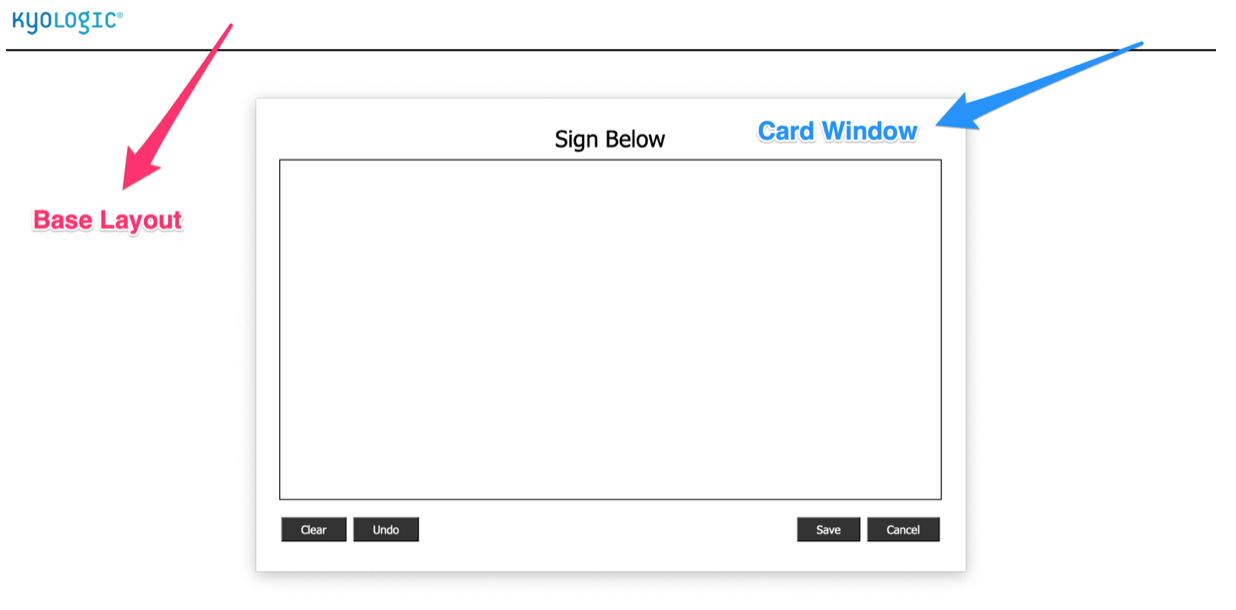
            Since the release of FileMaker 16, Card Windows have taken the FileMaker world by storm. They have allowed databases in FileMaker Pro and FileMaker Go to layer a window on top of another window as shown below.

Starting with FileMaker 19, this functionality has now been brought to WebDirect!

JavaScript in Web Viewers

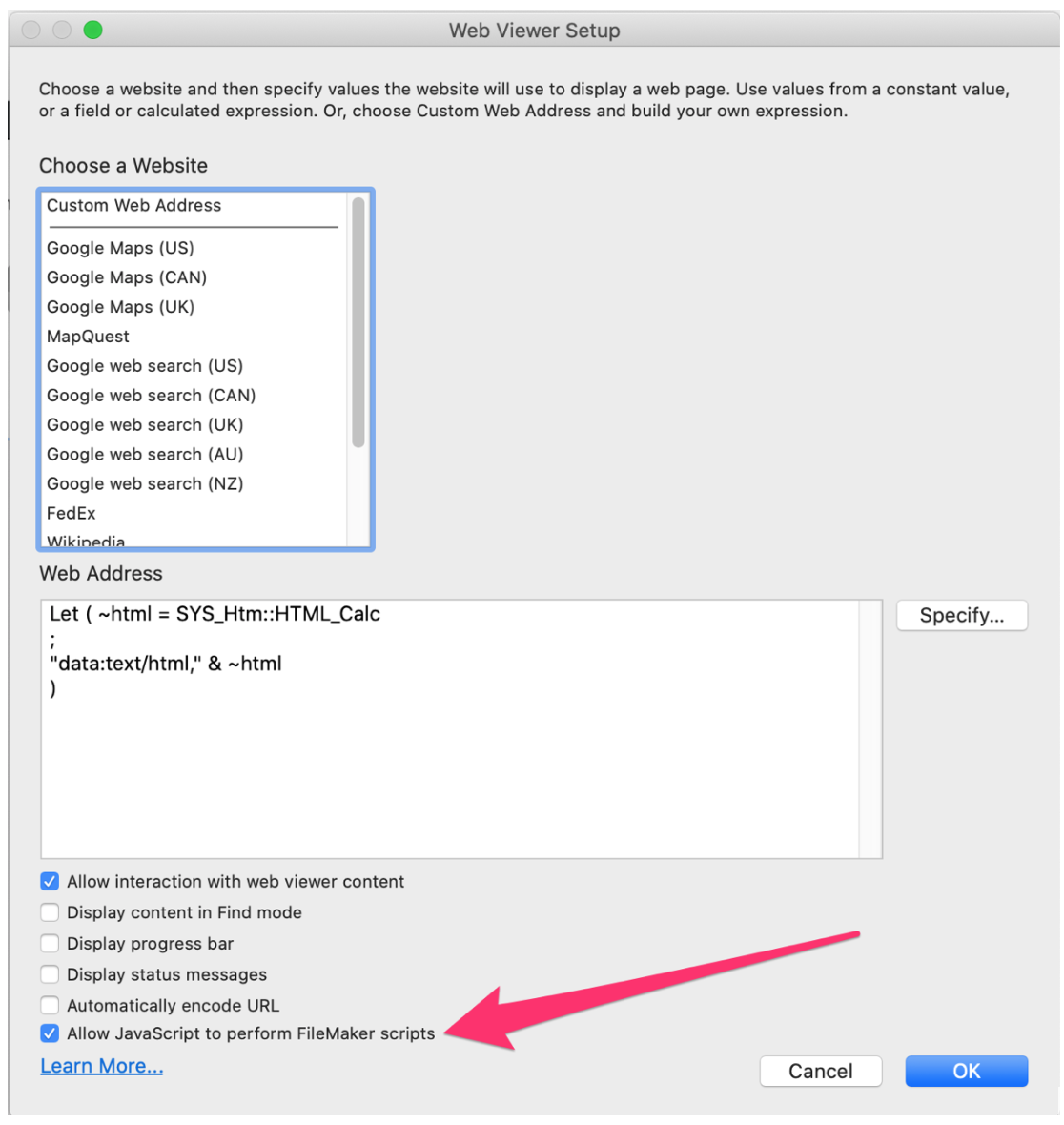
FileMaker has added a new function to Web Viewers called “Allow JavaScript to perform FileMaker scripts.” You can see below where to navigate to turn this on in the Web Viewer Setup.

What this allows you to do is enter the below JavaScript function into the JavaScript code in your Web Viewer. This will trigger a FileMaker script to be run as a result of an action taken within the Web Viewer.

[arve url=”https://kyologic.com/wp-content/uploads/2020/05/Signature.mp4″ /]

In the eSignature Application tool we utilize the open source signature pad code provided here https://github.com/szimek/signature_pad  (Thank you Szymon Nowak!) as the base for the web viewer code.

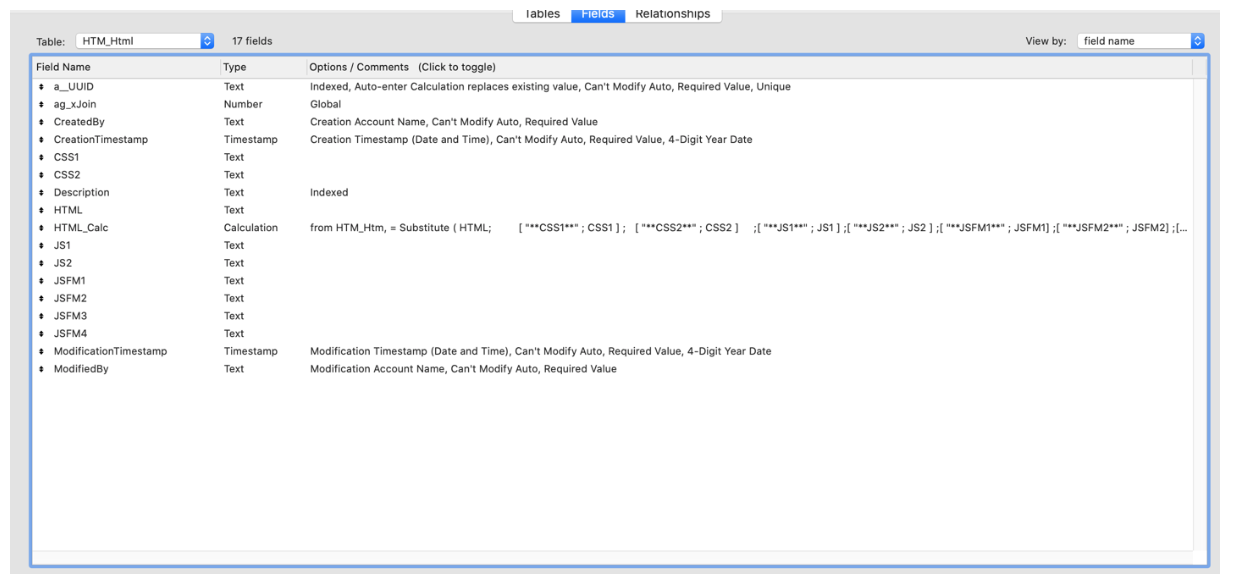
We have set up each element of the code in its own field in the HTM_Html table and combine the individual elements into the HTML_Calc field, which is what the Web Viewer reads and displays.

The elements in our code, which have been added to our FileMaker functions, are JSFM1 and JSFM2.

JSFM1 Is the Function that will be called upon selecting Save and JSFM2 upon selecting Cancel from within the Web Viewer.

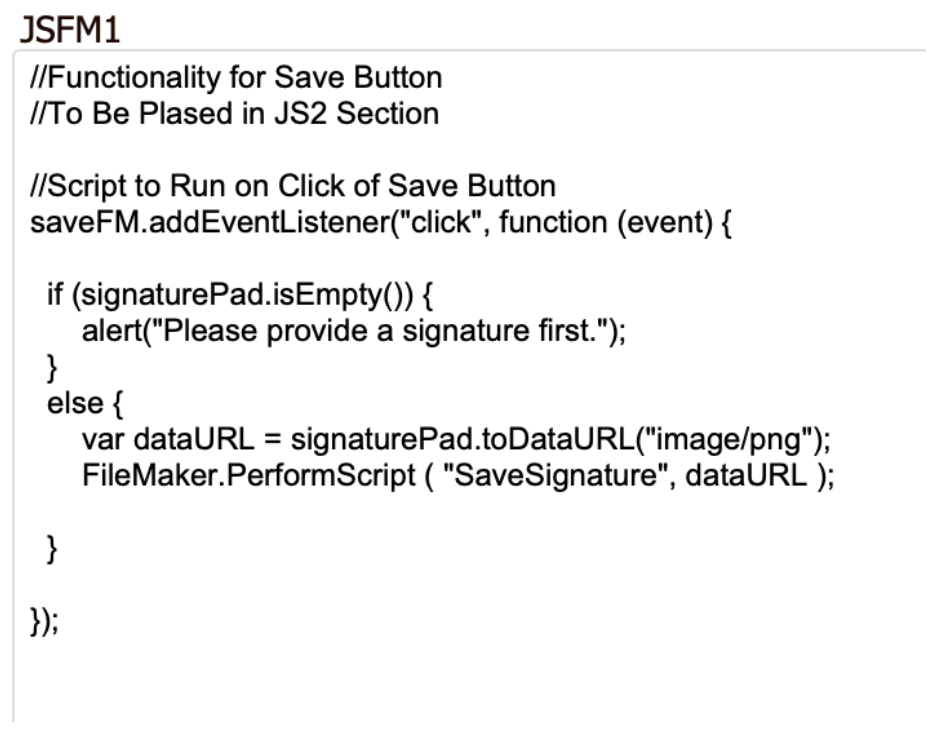
Here is a look at what the field JSFM1 contains:

As you can see here, when the Save button is clicked the function will run and, assuming that it is not empty, will first save the image as base 64 encoded text and then run the script SaveSignature in FileMaker.

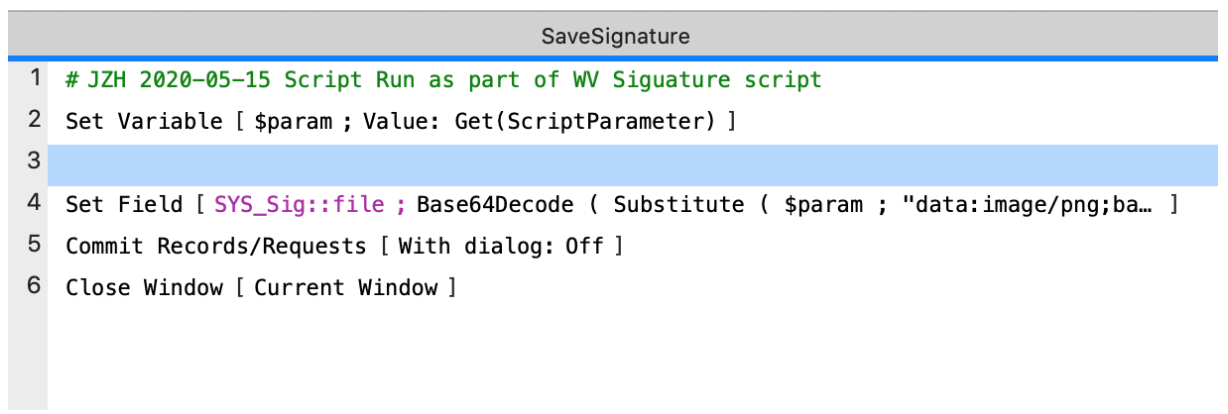
SaveSignature simply pulls in the dataURL as the parameter, decodes and formats it to be a png. Than sets it to the container field and closes the card window. It’s as easy as that. No more unnecessary data api work arounds!

It is important to note that with FileMaker 19, it is no longer necessary to base64 encode your web viewer code on WebDirect. In order for the FileMaker.PerformScript function to work from within a web viewer in WebDirect, the webviewer code cannot be base64 encoded and must start with datatext/html,

Download eSignature Application

Please complete this form to download the FREE file.

This field is for validation purposes and should be left unchanged.
Name(Required)

Here’s What We Found Interesting From WWDC18

Headline:

“Apple aims to put the customer at the center of everything we do”- Apple at WWDC18

This is something Kyo Logic and Apple have in common. We aim to provide the most user-centric services with everything we do, whether it is consulting, training, or FileMaker Development, making your business easier to run is our primary goal.

Here are some takeaways in iOS 12 that we found best upheld Apple’s promise:

Screen Time:

Smartphones have become an addiction, especially amongst the younger generation. Apple (being the number one contributor to that addiction) has begun to address this issue by implementing a new feature on iOS 12 called Screen Time. Screen Time provides you with a weekly report of how much time you have been spending on your iPhone, how often you check your iPhone, and what apps you’ve been spending the most time on.

The user-centric aspect of Screen Time is how customizable it can be. Users can:

  • Set limits for the time they spend on specific apps, with warnings when you get close to your limit
  • Set limits on their children’s devices remotely to help limit their usage
  • Set Downtime for when apps won’t be displayed and indicate when specific apps aren’t usable
  • Screen Time is Apple’s way to contribute to solving a social issue that they’ve helped create, all while keeping the user’s decisions to choose their settings in mind.

Security and Privacy:

In the tech world, people are always worried about their online presence, and whether their data is safe or not. Apple and Kyo Logic are two companies that show a similar drive to keep our user’s data safe. As per usual, Apple touched base on how up to date their security and privacy software is, but something especially interesting popped up that we found notable.

We have all seen the relentless “like” and “share” buttons on almost every website nowadays. These buttons can track and take down information from the user without even clicking them. Apple has made the stride to get rid of their user’s worry by disallowing this ability with iOS 12’s new Safari. To keep with Apple’s general theme of the conference of keeping the user at the center of everything they do, Apple has made this function optional. Every time one of these buttons is in effect, the user will have to allow access.

Apple is keeping the customer in the center of its update by thinking ahead of possible security threats, yet also allowing the user to bypass this security measure if they choose to do so.

Swift and The Apple Learning Community:

As any FileMaker user could tell you, coding is the language of technology and the future. Apple has been spreading the idea of how learnable the ability to code is through the implementation of Swift and Swift Playground. Both technologies have been out for a couple of years now, but Apple is pushing to get the public involved in coding for free.

Apps like Swift Playground make learning how to code very easy, and especially fun for inexperienced coders. Apple says, “We think everyone should have the opportunity to create something that can change the world. So we’ve designed a program that lets anyone learn, write, and teach code.”(Apple)

This entire movement falls under Apple’s overarching goal of the Apple Learning Community. Apple is pushing to get coding classes in all schools, enabling the next generation to create mind-blowing and groundbreaking apps that could change the world. For even more information on the Apple, Learning Community click here.

With the release of iOS 12, Apple includes an entire learning community with abilities of the public to become teachers and students to spread valuable knowledge.

By creating an available source of valuable education, and catering towards our youth, Apple has been continually showing us how customer-driven they are both for-profit and the betterment of society.

iOS 12 Beta

If you would like to access the Beta of iOS 12, click here, and help Apple make it their best release yet!

Work Cited:

iCrackUriDevice. “LIVE: Apple WWDC 2018 – IOS 12 & MORE – Video Stream (June 2018 Keynote)!” YouTube, YouTube, 4 June 2018, www.youtube.com/watch?v=61U4_ygZolo

“Everyone Can Code.” Apple, Apple.inc, www.apple.com/everyone-can-code/.

Welcome FileMaker 17!

FileMaker 17 Overview!

FileMaker 17 is finally here, and we are excited to review all the new features included! FileMaker releases new versions of the powerful database annually and this year may be the best release yet. In this post, we will review all the new features that have been released in FileMaker Pro Advanced, FileMaker Go, FileMaker Server, FileMaker Cloud, and FileMaker WebDirect. In separate articles, we will provide a more in-depth look at some of our favorite new features and a breakdown of the new licensing programs!

What’s New in FileMaker 17!

  • Layout Mode was redesigned for streamlined development
  • FileMaker now allows users to add default fields when you create new tables
  • FileMaker will now be able to handle multiple email attachments
  • FileMaker Data API is no longer a trail feature and supports scripts and uploading files to container fields
  • FileMaker Go will now support local notifications
  • Users can now drag and drop text, photos, and files between apps while using FileMaker Go!

Development

Group Object Selection

While developing in FileMaker you have had the ability to group together objects but when you needed to modify, reposition, or resize an individual object inside the group you would have to undo the groupings. With the Group Object Selection, you are able to select individual objects within a group and modify as needed.

Redesigned Layout Mode

FileMaker has redesigned layout mode for a more streamlined design environment. The Inspector, Fields tab and Objects tab will now be pinned inside the document window, so you will no longer lose them on other screens while working!

Default Fields

Most developers include a group of standard default fields in every application that is created, FileMaker has now added default fields to help streamline the process of creating new fields such as primary key, creation date, modification date, and who the record was created or modified by. Just add a new table within FileMaker and these fields will automatically be created. These fields can be customized or removed via an XML file.

Scripting Enhancements

FileMaker has added two new scripting enhancements to FileMaker 17. First, they have enhanced the Perform Script and Perform Script on Server script steps by adding the ability to specify which script should run by name. Second, They have added support for using variables in the input field to populate and retrieve text within a Show Custom Dialog script step.

Multiple Email Attachments

FileMaker has had the ability to send emails directly from your application for some time but up until now, users have been limited to only one attachment. In FileMaker 17 users will now have the ability to add multiple attachments when sending emails.

Copy and Paste Custom Menus

Save time while developing but reusing custom menus that you have created in other FileMaker apps. All you have to do is copy menu sets, menus, and menu items and paste them into your file!

FileMaker Data Migration Tool

Using the FileMaker Data Migration Tool developers will be able to cut the time it takes while importing large data sets in half. The new command-line tool will help when you update your deployed custom apps.

Deployment

FileMaker Server Admin Console

For easier administration of FileMaker applications, the FileMaker Server Admin Console was redesigned to provide a streamlined user interface. The Admin Console will feature a Dashboard page to easily monitor hosted apps, connected clients, and system statistics. Administrators will also receive notifications that will provide more detail on how to handle errors if they occur.

Work While Reconnecting

If a network connection to FileMaker Server is lost while you are working you will be able to continue working on files that do not depend on the host until the connection is restored.

Cloud

FileMaker Cloud will support all new features for FileMaker 17. Users will also have the ability to use the Comodo SSL certificate for 60-day free trails.

Mobility

Configure Local Notification

FileMaker Go will increase iBeacon technologies to include local notifications. Any iPad or iPhone that is using FileMaker Go that is running in the background will display local notifications such a meeting reminds, or when an iBeacon is near. Just set up scripts that will send local alerts based on info from your device!

Auto-Complete

Auto-Complete has been a great tool on the Desktop in FileMaker Pro but now this feature will be coming to FileMaker Go! Start typing a letter or two into a text field and a list of items that match what you are typing will appear!

Drag and Drop

FileMaker users will not have the ability to drag and drop text, photos, and files between apps on the iPad while running a minimum of iOS 11.

Integration

FileMaker Data API

FileMaker first introduced the FileMaker Data API as a trail in FileMaker Server 16 as an easy way to integrate your FileMaker data to other popular apps and we services using the industry standard REST API. In FileMaker 17 this will no longer be a trail and will include powerful new features including support for FileMaker Server scripts and the ability to upload files to container fields. FileMaker has also added more standardized API formats to make the FileMaker Data API easier to work with.

Security

Account Lockout

Security has been the main focus for FileMaker in the most recent releases. To continue strengthening security throughout the FileMaker Platform, users will now be temporarily locked out of accounts after failed login attempts. Users must wait 5 minutes before they can attempt to log back in.

To learn more about FileMaker 17 or incorporate these awesome new features in your FileMaker database today give Kyo Logic a call!

Introduction to FileMaker and SQL

Introduction to FileMaker and SQL

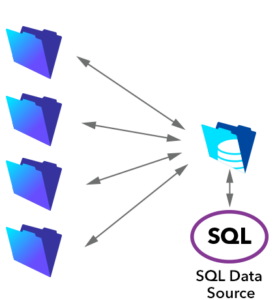
Are you looking for a way to take your FileMaker Database to the next level? Harnessing the power of SQL in FileMaker can help you streamline and easily access more of your data.

What is SQL and what are the benefits?

SQL is an abbreviation for structured query language and is a standardized programming language best used for managing a relational database. SQL also allows you to perform various operations on data and is used by developers to write data integration scripts and setting up and running analytical queries.

When using SQL in FileMaker you can there are many different benefits such as:

    • Quickly obtaining data for use in scripts
    • Versatility: Summarize, Join, Union, Find Within
    • Requires no persistent structures
    • Potentially very fast
    • Completely programmable

Well, this all sounds great but how do you get SQL to run in FileMaker?

With the latest versions of FileMaker, you can utilize the ExecuteSQL() function right within FileMaker which will allow you to perform select queries. SQL works well with Let functions and is often used to store data in global variables. Both simple or complex arguments can be entered into an SQL statement.

Additional FileMaker and SQL Recourses:
Conclusion

SQL is a great way to utilize your data in FileMaker. Whether writing simple or complex arguments you will be able to quickly use the ExecuteSQL() function in FileMaker to perform queries.

If you would like to harness the power of your data in FileMaker but do not want to do the heavy lifting contact us today.

Tips and Tricks for Creating Dashboards in FileMaker

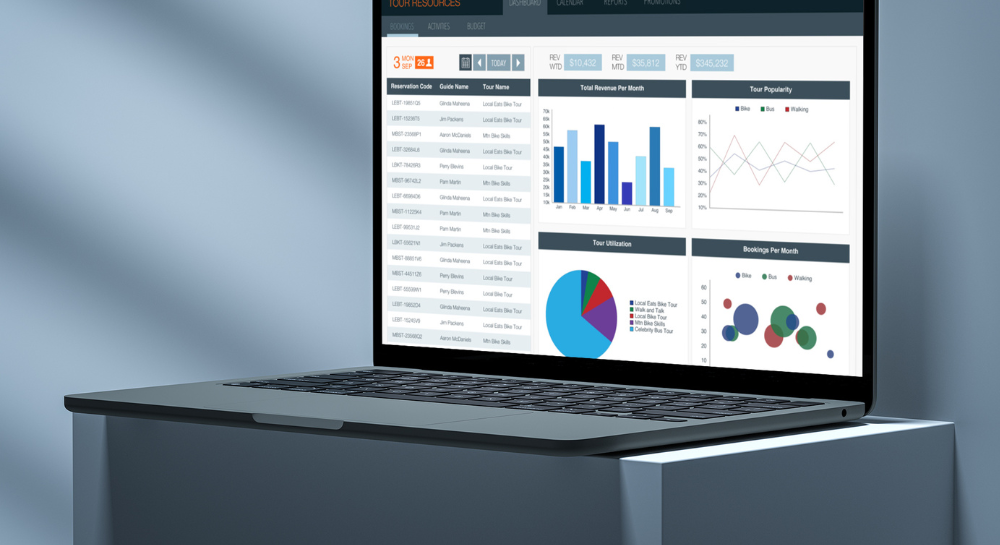
Do you have a FileMaker database that you use to manage your business processes? Are you looking for a tool that will allow you to see summarized and centralized data about your company in one easy view? Creating Dashboards in FileMaker will allow you to harness the power of your data to help your business run more efficiently.

FileMaker provides many excellent tools for creating powerful Dashboards that allow you to quickly scan information and identify important areas needing attention.

Follow along with John Mathewson of Kyo Logic as he walks through setting up and implementing Dashboards in FileMaker.

During the webinar you will learn: 

  • Approaches for creating dashboards
  • Tips for successful implementation in your organization
  • Using pivot tables and graphs
  • How to establish Key Performance Indicators (KPIs)

Download Dashboards Demo

Please complete this form to download the FREE file.

This field is for validation purposes and should be left unchanged.
Name(Required)

Kyo Logic Announces New Website

Norwalk, Sept. 1, 2017… Kyo Logic has launched their newly revamped website. The new site will include updated information about the services offered by Kyo Logic as well as a better understanding of the company’s value proposition and client benefits. The revamped site will have blog posts and press releases that are updated monthly for up to date industry news on custom software development and FileMaker.

The new site has enhanced functionality and a clean and streamlined design that puts a focus on the Kyo Logic mission to provide easy to use custom software to streamline client’s businesses. The new site will be launched September 1st and be compatible across all platforms.

“A website redesign is more than a fresh coat of paint, it’s an entirely new opportunity to engage with our clients in a deeper and more meaningful way. As someone who is client facing, there’s a lot to be excited about with this update” said Stoddard Horn, Sales Associate at Kyo Logic.

Kyo Logic’s new site will be updated regularly with new services, FileMaker news, and industry standards. We encourage visitors to leave feedback and sign up for our monthly newsletters for all the latest updates.

About the Kyo Logic:

Kyo Logic is located in Southern Connecticut and was started in 2002 with a goal to change the way you think about FileMaker Pro development projects. We create custom apps and integrated mobile solutions for clients across all business sectors.

With Certified Platinum level skills and thousands of hours of real-world production experience, we can build the powerful, customized and integrated software solutions you need. Our team leverages these advantages even further by providing our clients with shorter development times and lower overall project costs. We are able to do this because of our commitment to efficiency and our decades of combined experience. We also have a deep understanding of FileMaker and its power, functionality and flexibility, so we can bring the very best solutions to the table.

We extend our services to webinars, speaking engagements, educational opportunities, and workshops. We use each event as an opportunity become a better development partner.