
Manufacturers: The Consequences of Misaligned “Sources of Truth” in Your Data

Scaling businesses often face a frustrating operational hurdle: not a shortage of data, but an abundance of conflicting information.

Sales has one report. Operations has another. Finance’s numbers are slightly different. Leadership spends meetings reconciling discrepancies instead of making decisions.

When every department works from a slightly different dataset, trust erodes… and so does efficiency.

How Multiple Truths Develop

This issue usually emerges gradually:

  • Sales tracks activity in CRM exports
  • Operations manages workflows in spreadsheets
  • Finance relies on accounting software
  • Teams create department-specific reports to fill gaps

Each system serves a purpose, but without centralized alignment, data definitions begin to drift.

The Cost of Misalignment

When departments don’t share a unified data source:

  • Forecasts conflict
  • Reports require reconciliation
  • Decision-making slows
  • Accountability becomes harder
  • Leadership loses confidence in metrics

Even minor discrepancies create friction when teams depend on accurate numbers.

Why This Problem Scales Poorly

As organizations add products, channels, and customers, fragmentation compounds. More tools mean more reporting layers. More layers mean more opportunities for divergence.

Without a shared infrastructure, every department builds its own version of reality.

Creating a Single Source of Truth

A platform like Claris FileMaker enables organizations to centralize data across departments while preserving flexibility. Teams can:

  • Integrate multiple systems into one operational layer
  • Standardize metrics and calculations
  • Build department-specific views from shared data
  • Automate reporting across teams
  • Ensure everyone works from current, validated information

This eliminates conflicting datasets without forcing departments into rigid processes.

Why This Matters

Operational clarity depends on consistent data. When every team trusts the same source of truth, execution improves, and leadership can act faster.

If everyone has a different version of the truth, the problem isn’t your people, it’s your infrastructure. Centralized systems help align teams, improve confidence, and support smarter growth.

Interested in creating a unified operational system with Claris FileMaker? Reach out to Kyo Logic here.
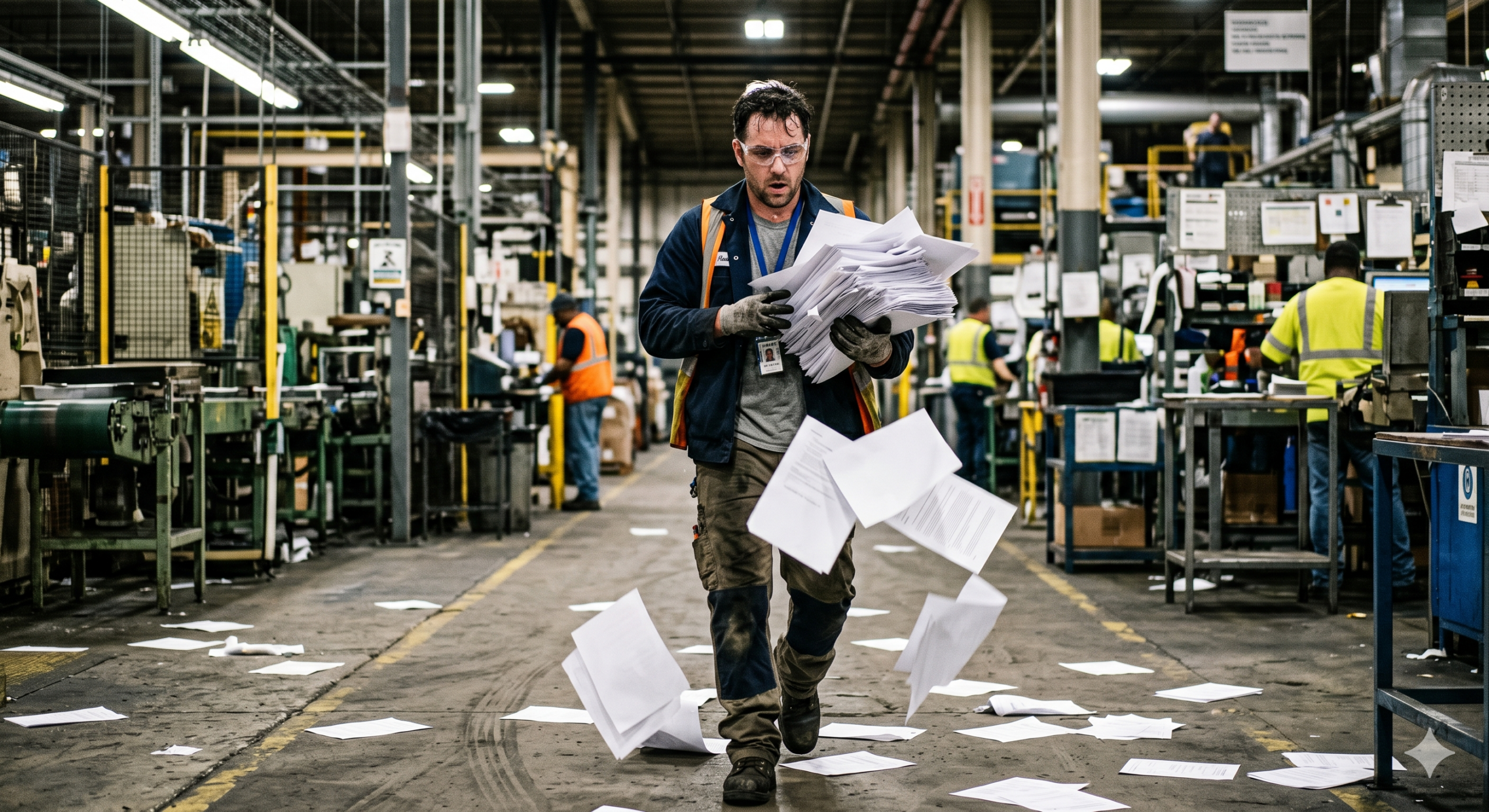

Manufacturers: Why Paperwork is Still Slowing Down Production

In many production environments, automation has improved machinery, scheduling, and logistics, but paperwork often remains surprisingly manual.

Forms, certifications, inspection sheets, compliance reports, and sign-offs still rely on paper, spreadsheets, or disconnected systems. While production processes evolve, documentation frequently lags behind.

The result? Administrative bottlenecks that quietly slow throughput.

Where Documentation Bottlenecks Appear

Paperwork often affects:

  • Quality control documentation
  • Compliance certifications
  • Production test records
  • Customer specification sheets
  • Shipping and receiving paperwork
  • Maintenance logs

These tasks are essential, but when handled manually, they consume time and introduce avoidable friction.

The Hidden Operational Drag

Manual or semi-manual paperwork creates:

  • Delays waiting for approvals or signatures
  • Re-keying information into multiple systems
  • Lost or incomplete records
  • Compliance risks from inconsistent documentation
  • Slower production handoffs

Even when the production floor is optimized, paperwork can quietly cap output.

Why It Persists

Manual documentation often survives because it feels familiar or compliant. Teams may assume digitization is disruptive or expensive.

But in reality, disconnected paperwork creates greater long-term costs.

Modernizing Documentation Workflows

This is where Claris FileMaker can significantly improve production environments. FileMaker allows organizations to:

  • Digitize forms and certifications
  • Automate approvals and routing
  • Capture test results in real time
  • Maintain centralized audit trails
  • Integrate documentation directly into production workflows

Paperwork becomes part of the production infrastructure and not just a separate bottleneck.

Why This Matters

When documentation moves as efficiently as production, teams reduce delays, improve compliance, and increase throughput.

If paperwork is still slowing production, the issue may not be operations… it may be infrastructure. Modernizing documentation workflows with Claris FileMaker helps manufacturers reduce friction and scale more effectively.

Interested in digitizing production paperwork and compliance workflows with Claris FileMaker? Reach out to Kyo Logic here.



Manufacturers: Here’s How Typical Onboarding Slows Down Operations

Hiring new employees is often a sign of growth. But for many organizations, onboarding takes far longer than expected. It’s not because new hires lack capability, but because systems rely too heavily on undocumented processes and tribal knowledge.

When workflows live in spreadsheets, emails, or individual memory, onboarding becomes slow, inconsistent, and difficult to scale.

How Onboarding Gets Slowed Down

Common friction points include:

  • Processes are explained verbally instead of being documented
  • Workflow steps spread across multiple tools
  • Key tasks dependent on experienced employees
  • Missing process visibility
  • Inconsistent training materials

Instead of learning a system, new employees often learn from people.

The Cost of Tribal Knowledge

When onboarding depends on tribal knowledge:

  • Ramp-up time increases
  • Productivity is delayed
  • Errors are more likely
  • Senior staff lose time training manually
  • Institutional knowledge remains vulnerable

This becomes especially problematic as teams grow quickly.

Why Growth Exposes the Problem

Small teams can often function informally. But as hiring accelerates, informal systems become operational drag.

Without structured workflows, every new hire increases complexity instead of capacity.

Building Structured Systems for Faster Onboarding

A platform like Claris FileMaker helps organizations embed knowledge directly into workflows by:

  • Standardizing processes
  • Automating task routing
  • Creating role-specific dashboards
  • Centralizing documentation and SOPs
  • Providing clear status tracking

This reduces reliance on individuals and accelerates employee readiness.

Why This Matters

Efficient onboarding isn’t just an HR function. It directly impacts operational scalability.

When systems effectively support employees, growth becomes smoother and more sustainable.

If onboarding takes too long, your business may be relying too heavily on tribal knowledge instead of structured systems. Building scalable workflows with Claris FileMaker helps organizations onboard faster, reduce friction, and support sustainable growth.

Interested in building smarter onboarding workflows with Claris FileMaker? Reach out to Kyo Logic here.

The Early Warning Signs Your Systems Won’t Scale

Most systems don’t fail all at once. They show signs.

At first, those signs are subtle: slightly longer reporting cycles, a few more spreadsheets, a little more back-and-forth between teams. But as your business grows, those small signals compound. What once felt manageable starts to strain.

Recognizing the early warning signs that your systems won’t scale is critical. The sooner you identify them, the easier it is to address the underlying issue before it impacts growth.

A practical checklist of warning signs

If you’re seeing several of the following, your infrastructure may be reaching its limits:

  • Reporting takes longer every month
  • Multiple versions of the same data exist
  • Teams rely heavily on spreadsheets to fill system gaps
  • Processes depend on specific individuals
  • Manual data entry is increasing, not decreasing
  • Errors become more frequent as volume grows
  • New hires take longer to onboard into workflows
  • Cross-team coordination requires constant communication
  • Simple questions require pulling data from multiple sources

Each of these signals points to the same underlying issue: systems that haven’t kept pace with operational complexity.

Why these signals matter

These aren’t just minor inefficiencies. They indicate that your current setup is approaching a threshold where:

  • Processes become harder to maintain
  • Throughput slows despite added effort
  • Decision-making becomes less reliable
  • Growth introduces more friction than momentum

Left unaddressed, these issues can quietly cap your ability to scale.

Why it’s easy to ignore the signs

In many cases, teams adapt to these challenges instead of solving them. Workarounds are created. Processes are adjusted. Extra time is built into workflows.

Because the system still functions, it’s easy to assume it’s “good enough.” But those adaptations often mask deeper limitations.

Preparing for the next stage of growth

A platform like Claris FileMaker helps organizations address these signals before they become bottlenecks. By centralizing data and automating workflows, teams can:

  • Reduce reliance on manual processes
  • Establish a single source of truth
  • Improve reporting speed and accuracy
  • Build systems that adapt as operations evolve

The goal isn’t just to fix current issues; it’s to create a foundation that supports future growth.

Scaling successfully requires more than adding customers or revenue. It requires systems that can support increased complexity without slowing down.

Identifying and addressing early warning signs ensures that growth remains sustainable.

The signs that your systems won’t scale are usually there; you just have to know what to look for. Addressing them early helps prevent operational drag and keeps your business moving forward.

Interested in building scalable systems with Claris FileMaker? Reach out to Kyo Logic here.